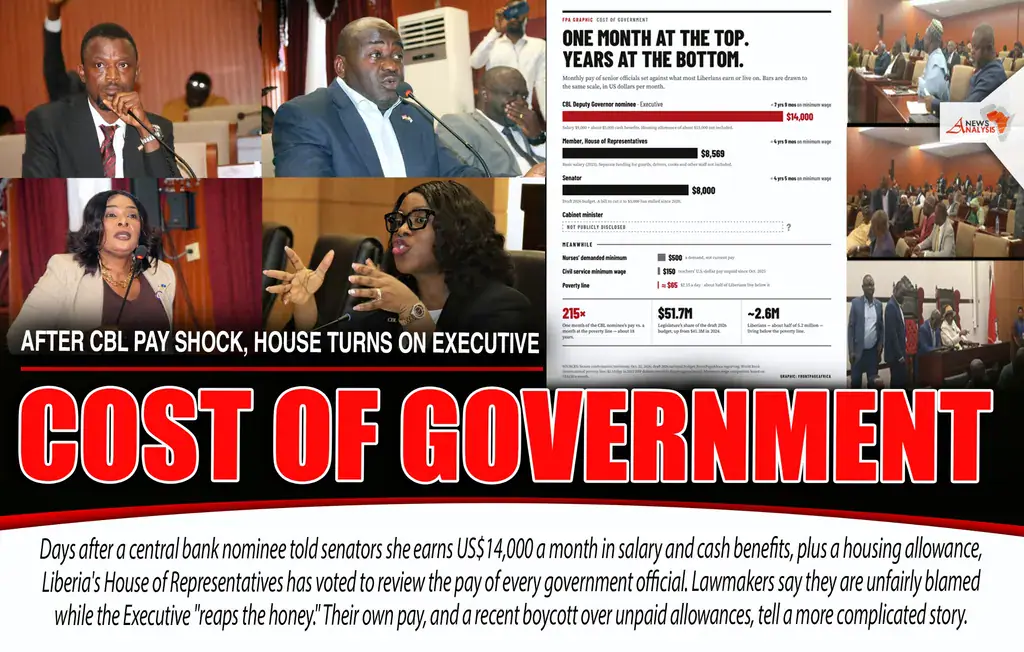
The Liberian House of Representatives has unanimously voted to instruct two of its committees, on Ways, Means and Finance and on Public Accounts, to examine the pay and perks of government officials and report back within two weeks. The motion was brought by Representative Alex S. Noah of Sinoe County. Lawmakers argued that they are wrongly blamed for the country's swollen wage bill, while ministers and the heads of state-owned enterprises earn far more.
The review comes after Euphemia G.T. Swen-Monmia, President Joseph Boakai's nominee for Deputy Governor for Economic Policy at the Central Bank of Liberia, disclosed her pay in a Senate Committee on Banking and Currency confirmation hearing on October 22. She testified that her monthly salary is US$9,000, with around US$5,000 in cash benefits on top of that, and a housing allowance of about US$15,000. This amounts to roughly US$168,000 a year in salary and cash benefits before housing is counted.
A civil servant on the government's US$150 monthly minimum would need more than seven and a half years of uninterrupted work to earn what Swen-Monmia receives in a single month. Swen-Monmia is a career central banker who joined the bank in 2010 as a management trainee and rose to director of its Financial Markets Department. The controversy is not about her qualifications but about what her testimony revealed: pay at the top of Executive agencies is generous, and almost never made public.
On the floor, several members described their own compensation as "peanuts" compared with Executive officials and argued the legislature deserves more because representatives serve larger numbers of constituents. Representative Moima Briggs-Mensah of Bong County said a US$2,000 budget line meant for constituents' school scholarships often never arrives, and that lawmakers lack the insurance enjoyed by Executive officials.
Representative Anthony Williams of Maryland County said lawmakers were being "falsely crucified" by the public while benefits such as fuel arrive months late. "The Executive, especially SOEs are reaping the honey, while we are being falsely crucified," he said, demanding that state enterprises disclose their gross and net pay and benefits to the House. The numbers tell a different story, however, with senators earning US$8,000 a month each, according to the draft 2026 budget.
The review was triggered by letters from two lawmakers who framed the problem differently from their colleagues on the floor. Representative Sumo Kollie Mulbah of Montserrado County asked the House to hold up the national budget until the Finance Ministry reports all salaries and benefits above US$5,000 a month for ministers, directors, county governors and commissioners. Representative Musa Hassan Bility of Nimba County called for a special committee to review salaries, allowances, wasteful spending, duty-free privileges and tax exemptions across all branches of government.
The two-week deadline for the review lands as the Executive prepares to send the 2027 budget to the legislature by October 31. The government projects total spending will fall to US$1.02 billion next year, meaning any gains for one group of officials will likely come at someone else's expense. The test is whether the committees follow Bility's call to start with the legislature, or whether the review becomes a selective exercise aimed at the Executive.
Key points
- The Liberian House of Representatives has ordered a review of government salaries and benefits amid controversy over the cost of running the country.
- The review comes after a senior official disclosed her pay, sparking debate over the generosity of executive compensation.
- The process may impact the 2027 budget, which the Executive is set to send to the legislature by October 31.