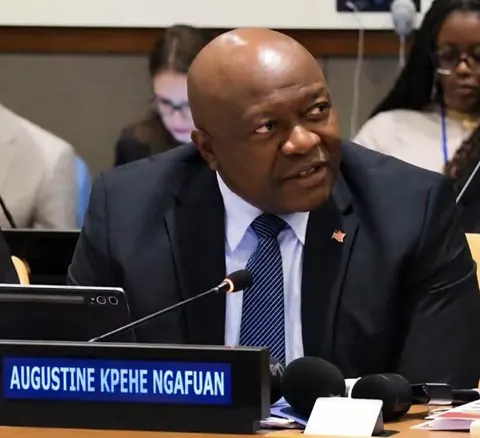
Liberia's Finance Minister, Augustine Kpehe Ngafuan, recently attended an investment roundtable in New York, held on the sidelines of the 81st Session of the United Nations General Assembly. During the event, Ngafuan presented Liberia's case for investment, highlighting the country's projected economic growth, political stability, and significant infrastructure needs. He emphasized that Liberia is open for serious business, with a stable and growing economy, and encouraged investors to consider opportunities in various sectors.
According to Ngafuan, Liberia's economy grew by 5.1 percent in 2025 and is expected to expand by about 5.5 percent in 2026, driven by sectors such as mining, manufacturing, and construction. The minister also disclosed that inflation averaged about 4.5 percent in the first half of 2026, while the Liberian dollar remained broadly stable. Additionally, domestic revenue surpassed US$1 billion for the first time, demonstrating stronger domestic resource mobilization as donor support declines.
Ngafuan acknowledged that Liberia still faces significant development challenges, including electricity, roads, and slow government decisions, which can deter serious capital. However, he argued that these gaps create openings for private investment. The government is seeking investment that can create jobs, expand agriculture and manufacturing, improve electricity access, and develop roads, logistics, and digital infrastructure. The minister emphasized that job creation is the government's central measure of economic success.
Electricity remains a major constraint on Liberia's economy, with access to power rising from about 31 percent at the end of 2024 to nearly 40 percent. The government aims to raise electricity access to at least 75 percent, while making power more reliable and affordable. Liberia is also seeking private investment in roads, logistics, and digital infrastructure through public-private partnerships. A road project worth over US$360 million, covering several corridors, was cited as an example.
To address investor concerns, Ngafuan assured that Liberia's investment framework allows investors to repatriate capital and profits, subject to applicable laws and tax obligations. He also highlighted the country's use of the United States dollar alongside the Liberian dollar as legal tender, which could offer familiarity to international investors. The minister emphasized that stability is a key selling point, citing Liberia's post-war democratic transition and peaceful changes of government.
The investment roundtable was organized by the Office of the Political Advisor to the President in collaboration with the National Investment Commission. Senior Liberian officials in attendance included Mines and Energy Minister R. Matenokay Tingban, Agriculture Minister J. Alexander Nuetah, and Posts and Telecommunications Minister Sekou M. Kromah. The government says it is seeking greater private-sector participation to finance infrastructure, create jobs, and support long-term economic growth.
Ngafuan's frank admission of Liberia's challenges and efforts to address them may prove to be his strongest selling point in a room of skeptical financiers. The minister's message mixed confidence with candor, acknowledging that Liberia's investment environment remains a work in progress. He asserted that the Liberia of today is better than the Liberia of yesterday and is working to improve the investment climate.
Key points
- Liberia's Finance Minister Augustine Kpehe Ngafuan is courting global investors with opportunities in various sectors, citing growth, revenue, and infrastructure needs.
- The government is seeking investment that can create jobs, expand agriculture and manufacturing, improve electricity access, and develop roads, logistics, and digital infrastructure.
- Ngafuan acknowledged Liberia's challenges, including electricity, roads, and slow government decisions, but emphasized efforts to address them and improve the investment climate.