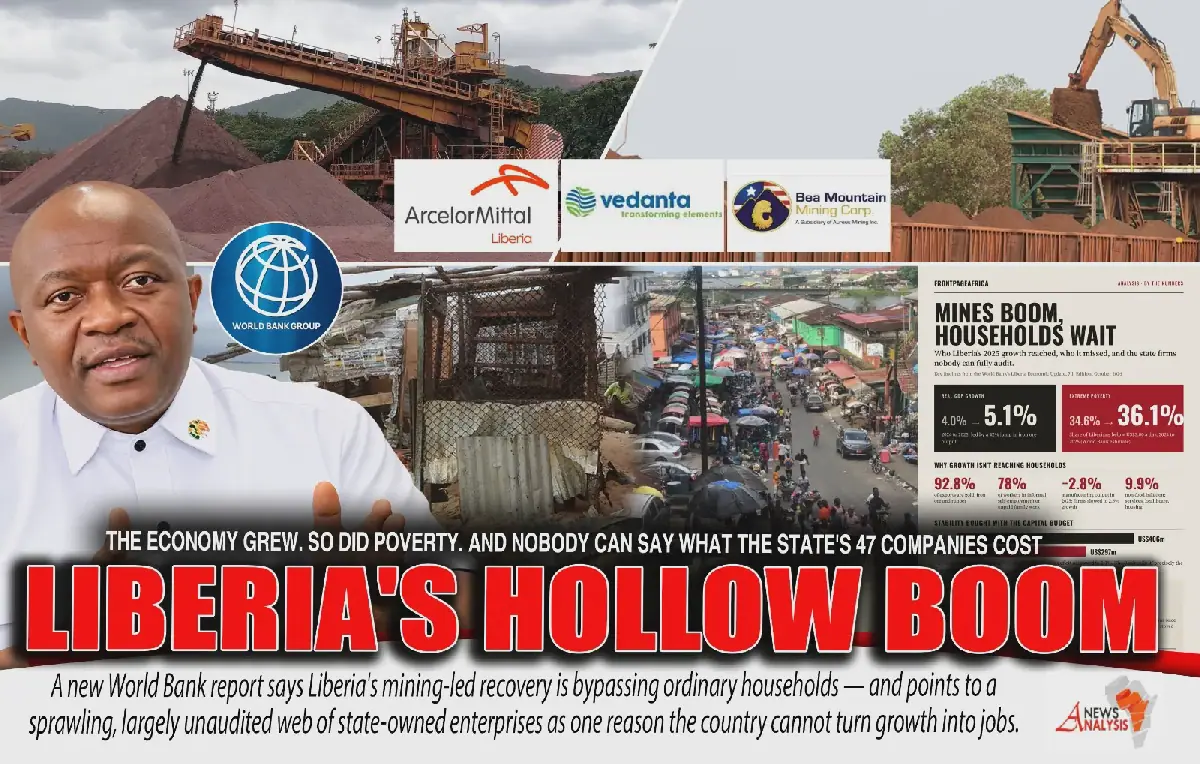
Liberia's economy experienced a 5.1% growth in 2025, its strongest pace in five years, according to the World Bank. The growth was driven by the mining sector, with iron ore production surging 42% and gold and iron ore accounting for 92.8% of the country's exports. However, the poverty rate increased to 36.1% of the population, with more Liberians slipping into extreme poverty. The World Bank's Liberia Economic Update report attributes this to a lack of job creation in sectors where Liberians work.
The report highlights a significant disparity between the sectors driving growth and those where Liberians earn a living. Industrial output jumped 10.8%, but manufacturing shrank 2.8%, and agriculture, which employs 39% of the workforce, slowed to 2.6% growth. The labor market also reveals a concerning trend, with 78% of workers in vulnerable employment, and wage jobs accounting for only 20.9% of employment. The report notes that about 55,000 people join the labor force each year, but the economy creates roughly 50,000 jobs.
The World Bank report also points to the squeeze on Liberians due to rising prices, particularly in non-food inflation, which climbed to 9.9%. Food inflation decreased after rice prices fell and the government cut the wholesale price of a 25kg bag of rice. However, the report expects poverty to ease to 33.2% in 2026 if farming recovers. The government's fiscal numbers improved, with the deficit narrowing to 2.1% of GDP, and domestic revenue rising to $830 million.
However, the report criticizes the government's decision to cut capital spending from $406 million to $297 million, which it says is "precisely the wrong adjustment." The report suggests that the government could generate more revenue by reducing tax exemptions, which were worth about $240 million in 2024, and by increasing its capture of fiscal value from the mining sector. The government's ARREST Agenda development plan requires roughly $8.4 billion over five years.
A major concern highlighted in the report is the lack of transparency and accountability in the state's portfolio of 62 government-owned entities, including 47 operating companies. Only 19 of these entities submitted financial returns to the state's oversight bureau in 2024, and 26 of the 47 active entities report nothing at all. The report notes that where auditors have looked, the picture is grim, with only 17 of the 47 entities having had even one General Auditing Commission audit since 2019.
The report also highlights the risks associated with the government's on-lent or guaranteed debt of $423.3 million from state-enterprise debt. The Liberia Electricity Corporation (LEC) is a prime example, holding about 77% of all liabilities reported by state firms, and its accounts have drawn adverse audit opinions year after year. The LEC reported modest losses of about $3.5 million over 2022-2024, but that was only after booking roughly $50 million in grant income.
The World Bank report calls for improved governance and oversight of state-owned enterprises, including the establishment of a governing board for the State-Owned Enterprises Authority of Liberia (SEAL). A House-passed bill barring sitting officials from state boards still awaits Senate action. The report emphasizes the need for transparency and accountability in the management of state-owned enterprises to mitigate the risks associated with their operations.
Key points
- The World Bank report highlights the need for improved governance and oversight of state-owned enterprises in Liberia.
- Liberia's economy grew 5.1% in 2025, but poverty increased to 36.1% of the population.
- The report criticizes the government's decision to cut capital spending, which it says is "precisely the wrong adjustment."