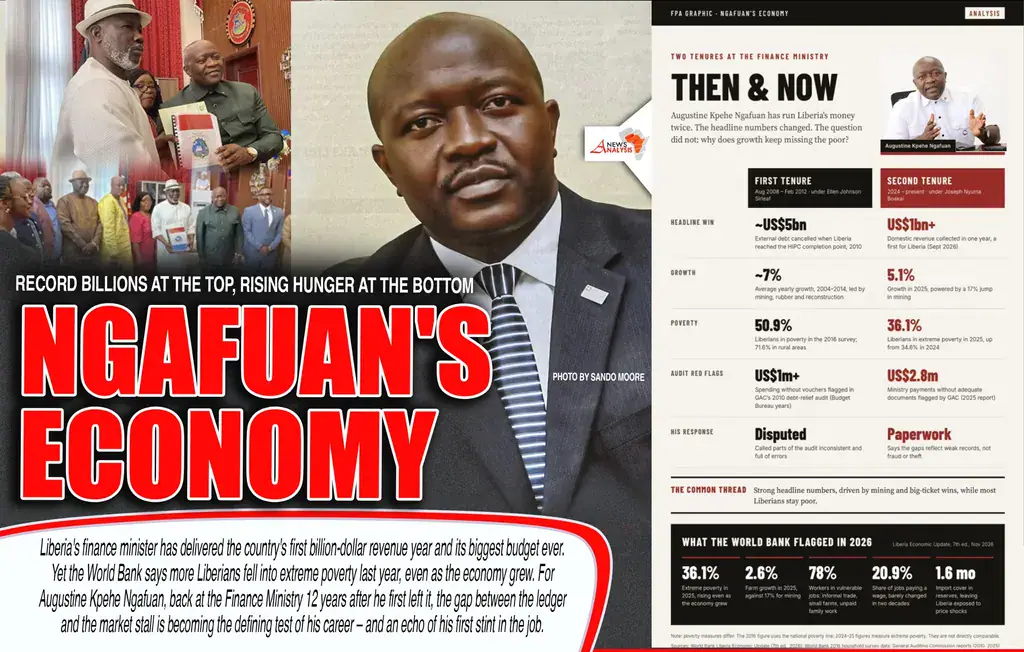
Liberia's Finance Minister, Augustine Kpehe Ngafuan, has reported record-breaking economic growth, with the Liberia Revenue Authority collecting over $1 billion in domestic revenue for the first time in September. The government has also proposed a $1.538 billion budget for 2027, the largest in Liberia's history. However, many Liberians remain unconvinced, citing rising hunger and poverty. Vendor Patrick Mamligar, who sells snacks on the streets of Monrovia, expressed skepticism about the government's claims of an improving economy.
The World Bank's recent Liberia Economic Update report highlights a paradox at the heart of Liberia's economy: while the economy grew 5.1% in 2025, extreme poverty rose from 34.6% to 36.1%. The report attributes this to the source of growth, which came primarily from mining output that jumped 17%, while agriculture, a crucial sector for most Liberian households, grew only 2.6%. This has resulted in a significant gap between economic growth and poverty reduction.
The World Bank report also notes that Liberia's labor market is characterized by vulnerable employment, with about 78% of workers engaged in street trading, small-plot farming, or unpaid family work. Wage jobs make up only 20.9% of employment, a share that has barely changed in two decades. Furthermore, the country's reserves cover only about 1.6 months of imports, leaving Liberia exposed to fluctuations in oil or food prices.
Critics, including opposition figures and independent analysts, have questioned Finance Minister Ngafuan's credibility, citing audit gaps and unreconciled revenue records. The General Auditing Commission flagged $2.8 million in ministry payments without adequate supporting documents, which Ngafuan attributed to a paperwork problem rather than theft. Some have called for his removal, citing serious failings in the Finance Ministry.
Amara Konneh, a former finance minister and current senator, has offered a nuanced perspective on Liberia's economic situation. While acknowledging the government's progress on stability, he notes that lower inflation is not the same as lower prices. Konneh points to rising domestic food prices, transport costs, and imported fuel prices, which are not reflected in the headline inflation rate.
Konneh proposes several fixes to address the disconnect between economic growth and poverty reduction. He suggests a single published schedule of port charges, regular Commerce Ministry price monitoring, and temporary relief for small businesses affected by delays. He emphasizes that stability is a means to an end, not the end itself, and that the government must prioritize the needs of ordinary Liberians.
The government's budget priorities have also come under scrutiny, with agriculture receiving less than 1% of recent national budgets. The ARREST Agenda, launched by President Joseph Boakai, aims to address this imbalance, but critics argue that more needs to be done to support the sector. As the government prepares to implement a value-added tax (VAT) in early 2027, Liberians may face higher prices, exacerbating the existing challenges.
Key points
- Liberia's economic growth has not translated to poverty reduction, with extreme poverty rising to 36.1% in 2025.
- The country's labor market is characterized by vulnerable employment, with most workers engaged in informal or precarious work.
- Critics argue that the government's budget priorities have not adequately addressed the needs of ordinary Liberians, particularly in the agriculture sector.
Reporting sources
- Liberia: Record Billions at the Top, Rising Hunger at the Bottom · FrontPage Africa