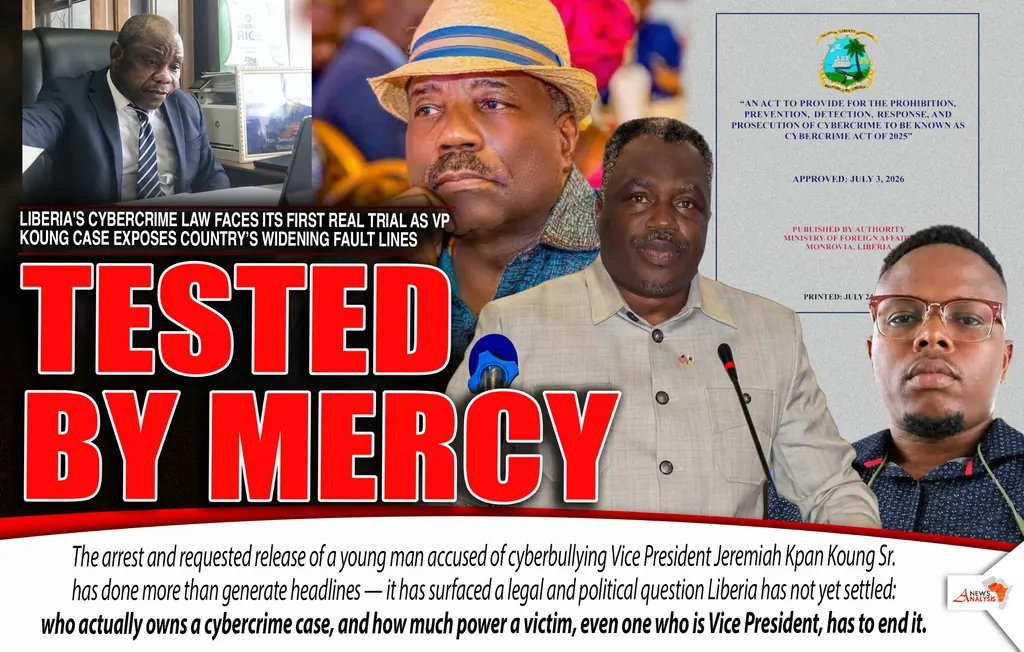
The arrest of Jerry Nyantee Wrotto, a young man accused of cyberbullying Vice President Jeremiah Kpan Koung Sr., has thrust Liberia's year-old Cybercrime Act into its first major public test. The Vice President's subsequent request for Wrotto's release has sparked a debate over free speech, criminal prosecution, and the limits of executive mercy. At the center of the controversy is a question with implications beyond the Vice President's office: Can an alleged victim withdraw a cybercrime complaint and end a prosecution, or does the state retain the authority to pursue the case in the public interest?
The debate has drawn sharply contrasting responses from Executive Protection Service (EPS) Director Sam Gaye and former Finance Minister Samuel D. Tweah Jr. Gaye defended applying the law to digitally manipulated content, while Tweah argues that Wrotto's arrest infringes on free expression. Vice President Koung has called for the suspect's release, framing his intervention as an expression of tolerance and restraint befitting public office. Garpue K. Wonlue, an Assigned City Solicitor and Prosecutor at the Ministry of Justice, challenged the legal effect of the Vice President's request, stating that "criminal cases are prosecuted in the name of the Republic, not the complainant."
Liberia's Cybercrime Act of 2025 was passed by the Senate in November 2025 and signed into law, filling a gap left by the country's 1978 Penal Code, which contained no specific cybercrime provisions. The legislation criminalizes several forms of digital misconduct, including unauthorized computer access, online fraud, identity theft, and electronic harassment. Its passage was intended to strengthen the country's response to cyber-enabled offenses. However, the Koung controversy is pushing the law into contentious territory involving artificial intelligence, political expression, and the boundaries of permissible criticism.
The Act does not explicitly reference artificial intelligence or deepfakes, raising questions about how its provisions should apply to AI-generated material and the circumstances under which such content constitutes a criminal offense. The controversy also follows an earlier incident involving a manipulated video of the Vice President at Brussels Airport. Wrotto had allegedly posted nude AI-generated photos and video of VP Koung, claiming he was subjected to screening at Brussels Airport.
Before Wrotto's arrest, EPS Director Sam Gaye publicly defended the police response to the alleged creation of the video, warning that digitally manipulated material intended to humiliate or harass individuals could attract criminal liability under the new law. Gaye stated that the law was signed by President Joseph Boakai on August 19, 2026, and criminalizes cyber-harassment and cyberbullying. He warned that cyber detectives would identify, arrest, and prosecute individuals engaged in such conduct.
Former Finance and Development Planning Minister Samuel D. Tweah Jr. has taken a sharply different position, welcoming Koung's intervention while arguing that the Vice President should never have had to request the release of a citizen accused of online speech-related conduct. Tweah described the cyberbullying law as draconian and predicted that it would be struck down after the Unity Party leaves power. He argued that the legislation conflicts with Liberia's history of press freedom reforms, including the Kamara Abdullah Kamara (KAK) Act.
The Koung controversy comes amid a wider debate over the reach of Liberia's digital laws and the safeguards protecting speech. The 2019 KAK Act decriminalized speech offenses such as sedition and criminal libel against the President, marking a significant press-freedom reform. However, a proposed 2026 amendment, the draft Protection from Gender-Based Online Abuse and Harassment Act, has raised concerns among press freedom advocates.
Key points
- The case has sparked a debate over free speech, criminal prosecution, and the limits of executive mercy in Liberia.
- The Cybercrime Act's provisions on AI-generated material and cyberbullying are being tested in the case.
- The controversy has raised questions about the role of the state in pursuing cybercrime cases and the authority of the alleged victim to withdraw a complaint.