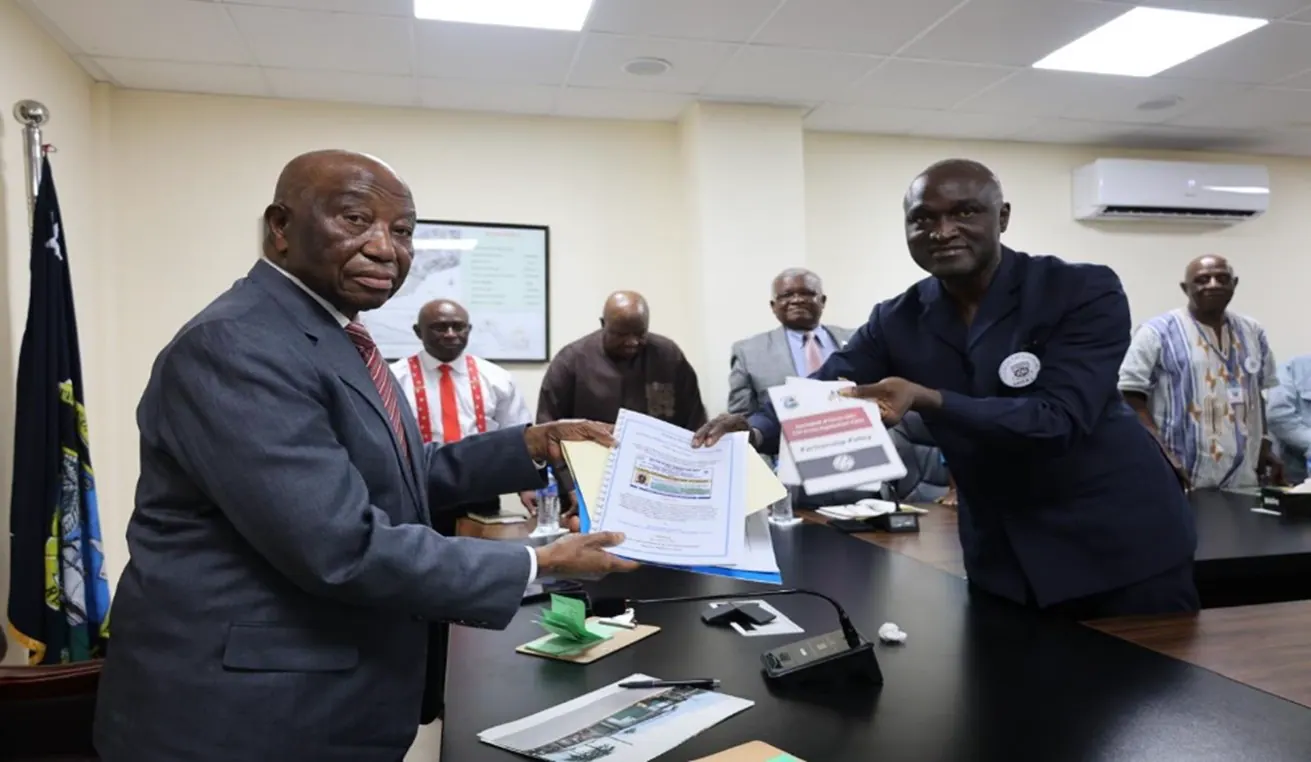
Liberia's civil society organizations are facing a severe funding crisis, with over 2,500 organizations struggling to survive after the withdrawal of the United Nations Mission in Liberia and the scaling back of major bilateral donor funding. A coalition of civil society organizations and elders is urging the government to allocate 0.1% of the national budget to address their sustainability crisis. This petition was adopted by the House of Representatives in June and presented to President Joseph Nyuma Boakai on September 1.
The petition, presented by Rev. Augustine S. Arkoi, Founder and Chief Executive Officer of the Better Future Foundation, and a delegation of elders and youth representatives, marks a significant milestone in Liberia's socio-economic and political development. The civil society organizations argue that domestic budgetary allocations are essential to guarantee national ownership and prevent civil society extinction. They cite international best practices, such as statutory civil society funds established in Ghana, Sierra Leone, South Africa, and various European democracies.
President Boakai has expressed appreciation for the presentation, highlighting its timeliness as his administration prepares the national budget for legislative debate. He commended the initiative and reaffirmed his commitment to inclusive governance under the ARREST Agenda for Inclusive Development. The President emphasized the vital role of an uncompromised civil society in national growth and underscored that civil society organizations must serve the nation beyond compromise.
The presentation of the CSO Sustainability Framework coincides with Liberia's celebration of 23 years of unbroken peace since the signing of the Comprehensive Peace Accord in Accra, Ghana, on August 18, 2003. The Accord served as a seven-point roadmap designed to transition Liberia from 14 years of civil devastation toward political tranquility and constitutional normalcy. Civil society leaders emphasize that while the Accord successfully ended armed conflict, the total withdrawal of UNMIL and the scaling back of major bilateral donor funding have created a severe operational vulnerability for domestic non-governmental organizations.
The proposed 0.1% Legislative Budgetary Appropriation fulfills Section 7.2.1.5 of the GoL/CSO Partnership Policy and the GoL-CSO Accord, which explicitly obligate the Liberian government to establish legal and financial mechanisms, including a dedicated Civil Society Trust Fund. The framework incorporates rigorous accountability mechanisms, requiring audited financial statements, tax compliance, non-partisan affidavits, and competitive proposal evaluations by an Independent Evaluation Panel as preconditions for CSOs to access the funds.
Alongside the CSO Sustainability Bill, the delegation submitted a comprehensive Memorandum/Executive Brief detailing critical policy recommendations to solidify national stability. Chief among them is the promulgation of an Executive Order for an Interim National Peacebuilding and Reconciliation Commission. This recommendation aims to promote peace and stability in Liberia and ensure that the country continues to move forward on the path of sustainable development.
The civil society organizations' push for a budget allocation and an interim peace commission reflects their commitment to promoting peace, stability, and sustainable development in Liberia. The government's response to these recommendations will be crucial in determining the future of civil society organizations in the country and the overall stability of Liberia.
Key points
- The Liberian government is urged to allocate 0.1% of the national budget to address the sustainability crisis facing over 2,500 civil society organizations.
- The civil society organizations are also pushing for the establishment of an interim National Peacebuilding and Reconciliation Commission through an Executive Order.
- The proposed budget allocation and peace commission aim to promote peace, stability, and sustainable development in Liberia.