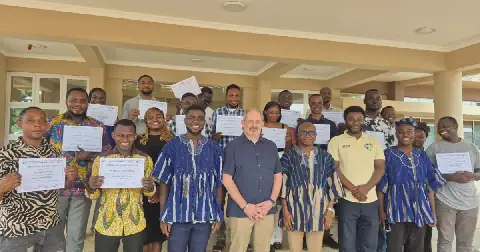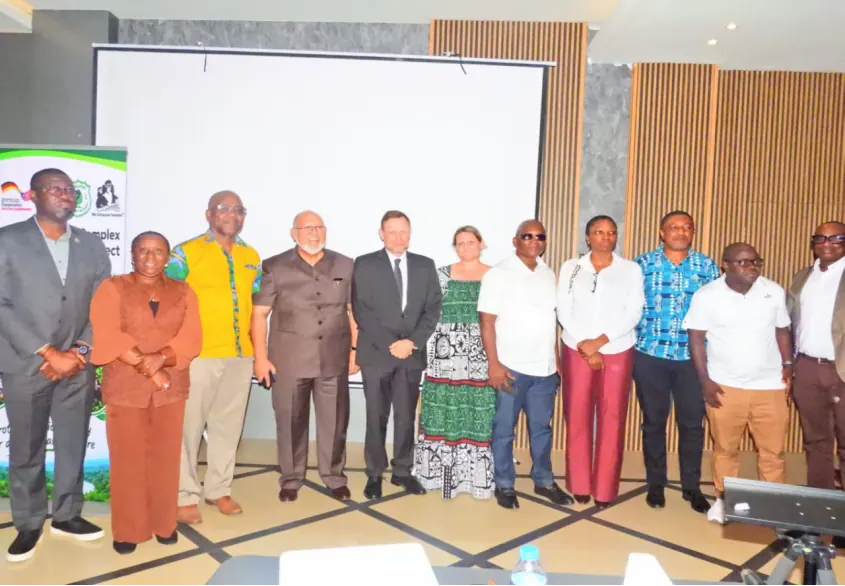
The Taï-Grebo-Krahn Complex Biodiversity Protection Project, a €4.7 million initiative, has been relaunched in Liberia after a seven-year suspension. The project aims to strengthen the protection of the Grebo-Krahn National Park, improve livelihoods in surrounding communities, and enhance cross-border conservation along the Cavalla River. Funded by Germany through KfW Development Bank and implemented by the Forestry Development Authority (FDA) in collaboration with the Wild Chimpanzee Foundation (WCF) and local communities, the project was officially relaunched at the Royal Grand Hotel in Sinkor, Monrovia.
The project was initially launched in 2017 with a budget of €6 million but was suspended in July 2019 due to delays in implementation and failure to meet financial and administrative conditions required by KfW. Following discussions between the FDA and KfW, the project was restructured, and its budget was reduced to €4,718,065.74. The revised project will focus exclusively on the Grebo-Krahn National Park, and the original plan to include the Sapo National Park and establish an ecological corridor between the two parks has been removed due to reduced funding.
FDA Managing Director Rudolph J. Merab emphasized that the success of conservation efforts depends on whether surrounding communities see tangible benefits from protected forests. He stressed that conservation should not be separated from the needs of people living around protected areas and that activities around protected forests can create jobs, generate income, and contribute to rural economic development. Merab urged stakeholders to ensure that the project produces visible and sustainable results for communities.
The redesigned project will improve infrastructure and equipment for the protection and management of Grebo-Krahn National Park. This includes the construction or rehabilitation of ranger posts, headquarters, park warden offices, and other facilities, as well as improvements to water and solar power systems. Infrastructure will be developed in areas including Ziah Town, Tempo, Freetown, Glayway, and Youbor. A dock post will also be constructed to support boat-based monitoring along the Cavalla River.
The project will provide equipment such as motorbikes, boats, and high-beam lights to strengthen surveillance and law enforcement. By May 2029, the project is expected to support the employment of 33 regularly employed rangers for the protection of the Grebo-Krahn National Park. It will also support ranger training, community forestry, livelihood programs, small-scale community infrastructure development, road maintenance, community engagement, research, and buffer-zone activities.
Dr. Annika Hillers, Country Director of the Wild Chimpanzee Foundation, welcomed the relaunch, describing Grebo-Krahn National Park as an important part of the Taï-Grebo-Sapo forest complex and one of West Africa’s remaining large connected forest areas. She emphasized that conservation cannot be achieved by the FDA and WCF alone and called for stronger collaboration among government institutions, particularly in addressing infrastructure and road challenges affecting communities around the park.
Local communities have expressed concerns that they must directly benefit from conservation programs. Representatives from River Gee County and Grand Gedeh County stressed the importance of ensuring that communities living closest to the forest see tangible benefits, such as improved roads, schools, and other basic services. They urged the FDA and its partners to approach community engagement with patience and transparency and to rebuild confidence among residents who have lived with restrictions associated with forest protection for years.
Key points
- The project aims to strengthen the protection of the Grebo-Krahn National Park and improve livelihoods in surrounding communities.
- The project was relaunched after a seven-year suspension and a restructuring of its budget and scope.
- Local communities have emphasized the need for tangible benefits from conservation programs.