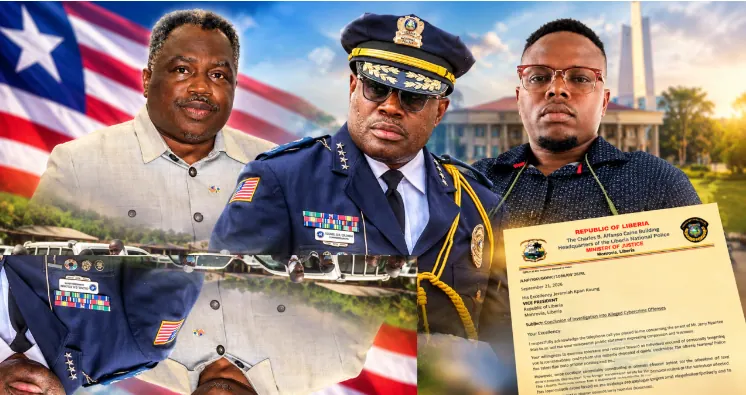
The Liberia National Police has concluded its investigation into Jerry Nyantee Wrato and will forward him to court on four cybercrime charges. This decision comes despite a public appeal from Vice President Jeremiah Kpan Koung for Wrato's release. In a letter to Koung, Inspector General Gregory O. W. Coleman stated that Wrato will face charges of Misuse of Devices, Cyberstalking, Distribution of Data Messages That Incite Damage to Property or Violence, and Distribution of Harmful Data Messages.
The charges against Wrato are alleged violations of Sections 10.1, 15.1, 18.1, and 19.1 of the Cybercrime Act of 2025. Coleman informed Koung that Wrato will be taken to court the following morning. The police's decision is based on their statutory responsibility to objectively investigate allegations, and they stressed that referring the case to court does not imply Wrato's guilt.
Wrato's arrest was prompted by AI-generated images and videos circulated on Facebook, which appeared to depict Koung in a derogatory manner. These images were linked to earlier controversy over reports of Koung's security screening at Brussels Airport, which Koung has denied. Executive Protection Service Director Sam Gaye defended the application of the Cybercrime Act to manipulated political content.
The Cybercrime Act, signed into law by President Boakai on August 19, 2026, has been in effect for barely a month. Its passage was led by the Senate, where Koung serves as President. This has raised questions about Koung's role as both the alleged victim and the head of the Senate that passed the law. Former Finance Minister Samuel D. Tweah Jr. has criticized the law as "draconian."
The case has sparked debate over whether a complainant can end a prosecution simply by declining to pursue it, given that criminal cases are typically controlled by the state. Legal commentators are examining this issue, and some have expressed concerns about the implications of the law. The police's decision to proceed with the case despite Koung's appeal has been seen as a test of the country's justice system.
Inspector General Coleman thanked Koung for his "tolerance and restraint" but emphasized that the police must investigate objectively. He noted that Wrato retains the presumption of innocence and all constitutional protections pending trial. The police's actions have been seen as a demonstration of their commitment to upholding the law, regardless of the individuals involved.
The case against Wrato has raised important questions about the balance between protecting individuals from cybercrime and safeguarding freedom of expression. As the case proceeds to court, it is likely to have significant implications for Liberia's justice system and its approach to regulating online content. The outcome will be closely watched by various stakeholders, including human rights groups and legal experts.
Key points
- The Liberia National Police will charge Jerry Nyantee Wrato with four cybercrime counts despite Vice President Jeremiah Kpan Koung's appeal for his release.
- The charges against Wrato are related to AI-generated images and videos that appeared to depict Koung in a derogatory manner.
- The case has sparked debate over the application of the Cybercrime Act and the role of the complainant in a prosecution.