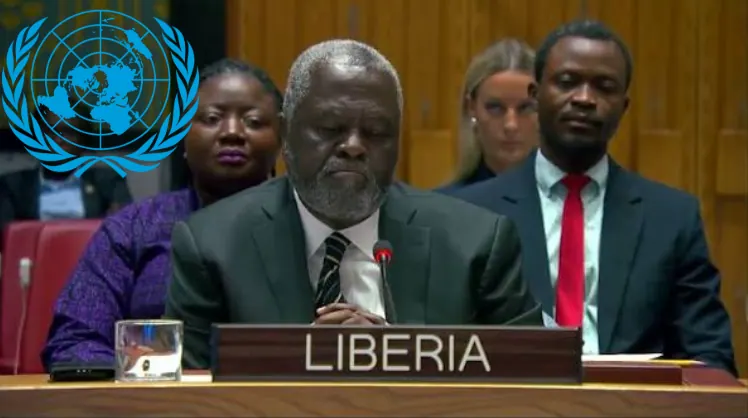
Liberia, one of the world's poorest countries, has failed to pay its annual dues to the United Nations, amounting to $34,000. This sum is the minimum rate set for the poorest nations, and it is an obligation that Liberia has met in the past. In 2017, Liberia paid its UN dues of $25,223 within the 30-day grace window. However, as of mid-September, Liberia had not settled its account, while its regional neighbors, including Côte d'Ivoire, Sierra Leone, and Guinea, had already made their payments.
Liberia's failure to pay its UN dues raises questions about its priorities, especially given its recent claims of fiscal improvement. The government has announced that domestic revenue has crossed $1 billion for the first time, a milestone it has been eager to publicize. Additionally, a supplementary budget for FY2026 shows total receipts of $53 million, built on $48 million in World Bank budget support and a $5 million surplus over projections.
Liberia's maritime registry is one of the largest in the world, and the country has a history of promptly settling its dues to the International Maritime Organization, a separate UN body. In both 2024 and 2025, Liberia paid roughly $7.1 million, about 15% of the agency's entire budget, without incident. This makes the country's current lapse in paying its UN dues harder to explain as a matter of means.
The UN's Committee on Contributions maintains a Honour Roll, which tracks member states' payments. As of September 14, 139 of the UN's 193 members had paid in full, but Liberia was not among them. Côte d'Ivoire, with a considerably larger economy, paid its assessment of $763,551 in March, while Sierra Leone and Guinea followed suit in September.
Liberia's current non-payment does not yet trigger real consequences, such as the loss of its General Assembly vote, which would require arrears equal to two full years of assessments, approximately $68,000. However, the symbolism of not being on the Honour Roll may have its own currency at the UN. Liberia currently sits on the UN Security Council as a non-permanent member for the first time since 1961.
The question of priorities is especially pertinent given Liberia's recent messaging on its fiscal turnaround. The government has highlighted its domestic revenue milestone and supplementary budget, but it is difficult to square these claims with a $34,000 UN bill left unpaid. This discrepancy may raise concerns about Liberia's commitment to its international obligations.
Liberia's situation may also reflect broader challenges in its governance and financial management. The country's failure to pay its UN dues, despite its claims of fiscal improvement, may indicate a need for greater transparency and accountability in its financial dealings. As the government seeks to rebuild public trust, it will need to address these inconsistencies and demonstrate a commitment to meeting its international obligations.
Key points
- Liberia owes $34,000 to the UN, a sum it has yet to pay, despite recent claims of a fiscal turnaround and a $1 billion domestic revenue milestone.
- The country's failure to pay its UN dues raises questions about its priorities, especially given its recent claims of fiscal improvement.
- Liberia's situation may reflect broader challenges in its governance and financial management.