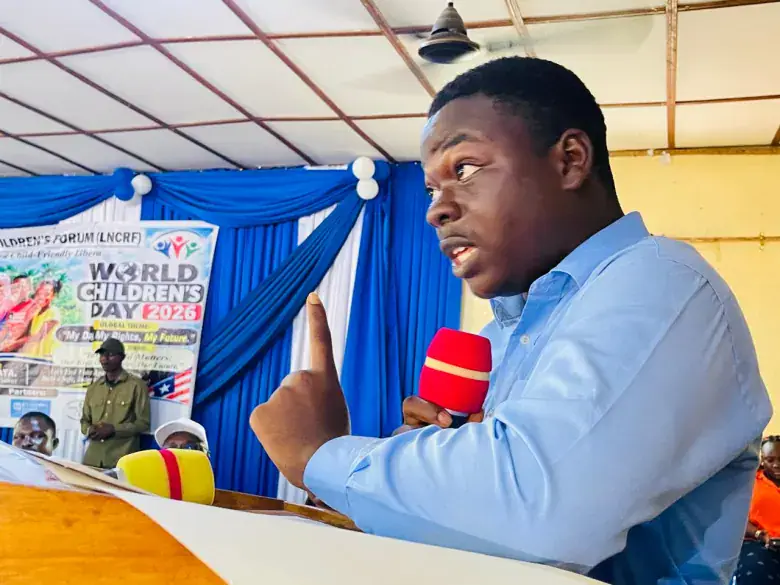
The Speaker of the Liberia National Children Representative Forum (LNCRF), Michael Wesseh, has urged the Liberian Government and development partners to prioritize children's welfare and development. He made the call during the celebration of World Children's Day in Kakata City, Margibi County. Wesseh emphasized that children should not be treated as an afterthought in Liberia's national development agenda. He cited the preamble of the Children's Law of Liberia, 2011, which recognizes children as the pillars and cornerstone of a greater Liberia.
Wesseh argued that government planning, budgeting, policymaking, and decision-making must prioritize children's welfare and development. He cautioned against using children as political tools or remembering them only during political campaigns and public ceremonies. According to him, children should not be used as political tools and should be remembered beyond campaigns and ceremonies. Wesseh referenced Section 23 of the Children's Law of Liberia, which provides a foundation for children's participation and expression.
The LNCRF Speaker reflected on discussions held during the World Children's Day celebration, where children demonstrated that they have ideas, solutions, and a vision for a better Liberia. He referenced an interactive session in which children were asked what they would do if given the opportunity to become President of Liberia for one day. Some children proposed strengthening healthcare services and improving the quality of education, while others called for stronger measures to protect children from violence in schools and communities.
Wesseh advocated for the establishment of safe spaces across the country where children could freely express themselves, feel protected, and participate in decisions affecting their lives. He maintained that children are not short of ideas but need leaders and institutions willing to listen to their concerns and act on their recommendations. The LNCRF Speaker also called for collective efforts to end violence against children, emphasizing that the responsibility should not rest solely with one institution or individual.
Wesseh urged the Government of Liberia, parents, schools, communities, civil society organizations, and development partners to work together to protect children from violence, abuse, exploitation, and neglect. He stressed that every child deserves to feel safe at home, in school, in the community, and everywhere they go. Wesseh also called on the Ministry of Gender, Children, and Social Protection to ensure that workshops, training programs, and policies translate into practical child-protection interventions and measurable improvements in children's lives.
The LNCRF Speaker clarified that the forum's concerns were not intended to condemn the government but to highlight the realities children face and encourage collective responsibility in addressing them. Wesseh further stressed that children should be recognized as partners in shaping Liberia's future rather than merely beneficiaries of development programs. He noted that children's participation should extend beyond radio appearances, public ceremonies, and other social engagements to include policy development, budget preparation, and national decision-making processes.
Wesseh expressed appreciation to the Ministry of Finance and Development Planning for an announced allocation of US$50,000 to the Liberia National Children's Representative Forum. He described the support as an important contribution toward strengthening the institution's work and advancing children's representation and participation in national development. Wesseh challenged national leaders to consider the future of children in their present-day decisions, particularly in education, healthcare, protection, and resource allocation.
Key points
- Children should be prioritized in Liberia's national development agenda.
- Collective efforts are needed to end violence against children.
- Children's participation should extend beyond social engagements to policy development and decision-making processes.