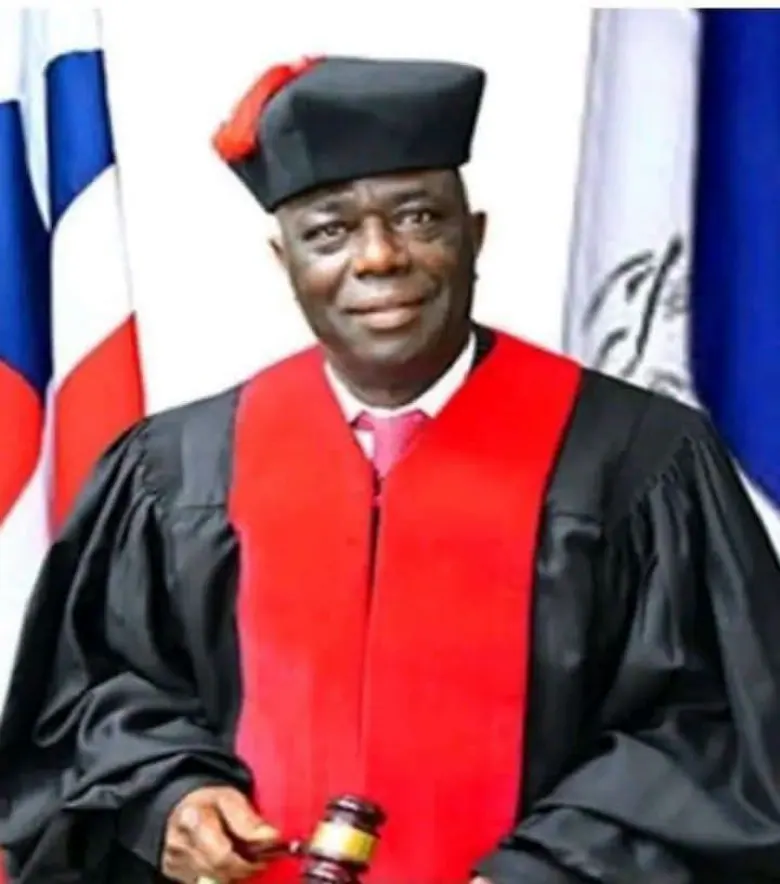
Liberia's Chief Justice, Yamie Quiqui Gbeisay, has addressed public reactions to a recent court ruling in the Kalefa Turay Land Dispute case in Gompa City, Nimba County. The court's decision resulted in the eviction of some occupants, sparking concerns among locals. Chief Justice Gbeisay emphasized that his loyalty is to the Constitution and laws of Liberia, not to any tribe, county, or party involved in a case. He assured the public that justice will be administered without fear or favor.
The controversy began when the Gompa City Magisterial Court ruled in favor of the Turay Family, who claimed ownership of the disputed land. The court's decision was based on a public land sale deed signed by former President William V.S. Tubman in 1951. According to Chief Justice Gbeisay, the Turay Family purchased the land and constructed buildings, which were leased to tenants, including the Government of Liberia, until the civil crisis.
Chief Justice Gbeisay strongly condemned attempts to use tribal sentiments to influence court decisions. He stated that courts base their rulings solely on evidence and that there is no recognition of tribal affiliations in the Temple of Justice. The Chief Justice emphasized that his oath of office requires him to administer justice equally to all persons, without regard to tribe or affiliation.
The Chief Justice's statement comes amid criticism of the court's decision, with some individuals accusing him of being a "tribal Chief Justice." In response, Chief Justice Gbeisay reaffirmed his commitment to upholding the Constitution and defending legally rendered judgments throughout Liberia. He welcomed constructive criticism but warned against the deliberate use of tribal identity to intimidate the judiciary.
The Gompa City Magisterial Court ruling is not an isolated incident. Recently, former Ganta City Mayor Amos N.G. Suah was sentenced to 30 days in jail for remarks he made about the Gompa Magisterial Court during an eviction process in Ganta. The incident highlights the sensitivity of land disputes in Liberia and the need for impartial justice.
Chief Justice Gbeisay's statement has been seen as a reassurance to the public that the judiciary remains committed to upholding the law. He emphasized that land disputes must be decided in the courtroom, based on evidence and law, rather than in the streets or through social media. The Chief Justice's stance has been welcomed by those seeking to promote stability and justice in Liberia.
The Kalefa Turay Land Dispute case serves as a reminder of the complexities surrounding land ownership in Liberia. The case highlights the need for clear land tenure systems and effective dispute resolution mechanisms. As the Chief Justice continues to uphold the law, his commitment to justice and equality will be closely watched by Liberians.
Key points
- Chief Justice Yamie Quiqui Gbeisay emphasizes that his loyalty is to the Constitution and laws of Liberia, not to any tribe or party involved in a case.
- The Gompa City Magisterial Court's decision in the Kalefa Turay Land Dispute case was based on a public land sale deed signed by former President William V.S. Tubman in 1951.
- Chief Justice Gbeisay strongly condemns attempts to use tribal sentiments to influence court decisions, reaffirming his commitment to upholding the Constitution and defending legally rendered judgments.