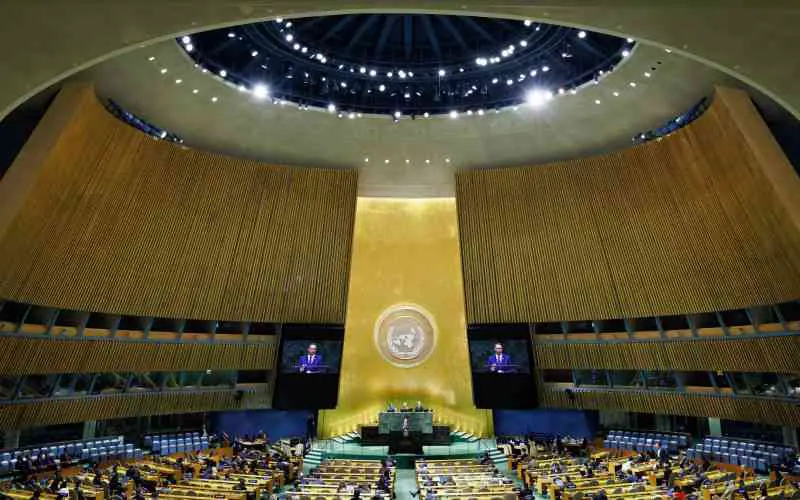
As the 2026 United Nations General Assembly commences in New York, the focus shifts to reparatory justice for victims of slavery, colonial exploitation, and other historical injustices. For generations, these victims have been asked to wait for acknowledgement, dialogue, consensus, and the right political moment. The United Nations has taken a significant step by adopting a resolution on March 25, 2026, declaring the trafficking of enslaved Africans and racialised chattel enslavement of Africans the "gravest crime against humanity".
The resolution received 123 votes in favour, three against, and 52 abstentions. Although this vote was historic, it fell short of providing redress. The message to UNGA 2026 should be clear: do not offer another declaration and ask for another generation of waiting. Reparatory justice cannot remain a diplomatic ritual where leaders express regret and acknowledge suffering without confronting the material consequences of history.
The transatlantic trafficking and enslavement of Africans was not only a moral tragedy but also an economic and political system that extracted labour, wealth, and human potential on an industrial scale. Its consequences persisted even after slavery was abolished, carrying into colonialism and unequal structures of the modern international economy. Reparatory justice encompasses truth, restitution, compensation, rehabilitation, institutional reform, cultural recovery, development, and guarantees that systems of racial domination are not reproduced.
The March resolution recognised the enormity of enslavement and its enduring consequences. The challenge now is to give that recognition institutional teeth. The growing diplomatic weight of the Global South, particularly African and Caribbean states, becomes consequential in this context. These states have an opportunity to translate their numerical strength at the General Assembly into coordinated diplomatic, legal, and negotiating capacity.
The African Union's decision to make 2026–2036 the Decade of Reparations provides a framework for moving the issue beyond episodic declarations. However, political momentum without an architecture for delivery risks producing another cycle of promises. A durable international mechanism is required to gather evidence, preserve archives, document claims, assess continuing harm, develop legal positions, and facilitate negotiations.
The experience of the Marshall Islands serves as a warning. The United States conducted 67 known nuclear tests in the Marshall Islands between 1946 and 1958, resulting in displacement, environmental damage, health effects, and cultural loss. Incomplete records and unresolved questions of accountability continue to obstruct justice. A 2026 UN analysis highlighted the obstacles to justice posed by fragmented historical, environmental, and health records.
The debate at UNGA 2026 should shift from whether reparations are justified to practical questions of how historical harm is documented, who bears responsibility, what forms of redress are appropriate, and how progress is measured. Reparatory justice is not charity but accountability. As Barbados Prime Minister Mia Mottley argued, the consequences of history continue to shape development prospects, debt burdens, climate vulnerability, cultural loss, and missed opportunities.
Key points
- The United Nations adopted a resolution on March 25, 2026, declaring the trafficking of enslaved Africans and racialised chattel enslavement of Africans the "gravest crime against humanity".
- The African Union has designated 2026–2036 as the Decade of Reparations to push for reparatory justice.
- A durable international mechanism is needed to facilitate reparatory justice, including gathering evidence, preserving archives, and documenting claims.