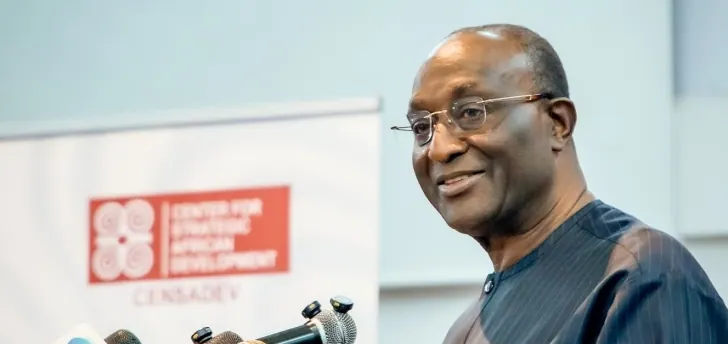
Former Minister of Trade and Industry, Alan Kyerematen, has urged Ghana to shift towards a private-sector-led economy to achieve sustained growth. He made this call at a public lecture organised by the Centre for Strategic African Development (CENSADEV) in Accra on September 24. Kyerematen emphasized that private initiative and ownership are crucial for the country's economic transformation. He also stressed the need for industrialisation, agricultural transformation, export expansion, and an enabling business environment.
Kyerematen, a former Minister of Trade and Industry, stated that Ghana cannot build an enterprise economy when citizens and businesses remain overly dependent on the government. He added that supporting private-sector growth would promote entrepreneurship, innovation, and risk-taking. According to him, this is the only way to save the country. Kyerematen also called for an institutionalised public-private dialogue mechanism to enable businesses to engage the government on policies and regulations affecting their operations.
The Founder of the United Party (UP) identified oil palm, cassava, garments, and textiles as strategic industries with potential for employment creation and value addition. He also advocated for the greater use of Ghana's bauxite and iron resources to produce aluminum and steel locally. This, he believes, can support the assembling of automobiles and other manufacturing activities. Kyerematen proposed increasing revenue from non-traditional exports to $25 billion by 2030, from the current level of just over $3 billion.
On agriculture, Kyerematen called for a mass participation regime for Ghanaians, where the government supports citizens to own farms and operate them as businesses rather than solely for subsistence. He also proposed reforms in taxation and revenue mobilisation, including the consolidation of statutory charges at the ports. Additionally, Kyerematen suggested that at least 40 per cent of shares in viable state-owned enterprises (SOEs) be listed on the stock exchange to enable ordinary Ghanaians to participate in their ownership.
Kyerematen commended the government for reducing inflation and stabilising the cedi but cautioned against relying excessively on foreign-exchange reserves to sustain currency stability. He warned that speculators would take advantage of this approach. Instead, he emphasized the need for stronger exports and greater confidence in the economy for sustainable currency stability. Kyerematen's proposals aim to transform Ghana's economy from stability to sustained growth.
The Executive Director of CENSADEV stressed that macroeconomic stability alone cannot transform the economy, and industrial transformation is necessary. He cited the development history of major economies, which shows a strong link between industrialisation and economic strength. Kyerematen's vision for Ghana's economic transformation involves a strong private sector, industrialisation, and a supportive business environment.
Kyerematen's call for a private sector-led economy has significant implications for Ghana's economic development. His proposals aim to promote entrepreneurship, innovation, and job creation. The implementation of these proposals will require a collaborative effort from the government, private sector, and citizens. Key points include:
Key points
- Private sector-led economy is crucial for Ghana's economic transformation.
- Industrialisation and agricultural transformation are necessary for sustained growth.
- Reforms in taxation and revenue mobilisation are required to support economic development.