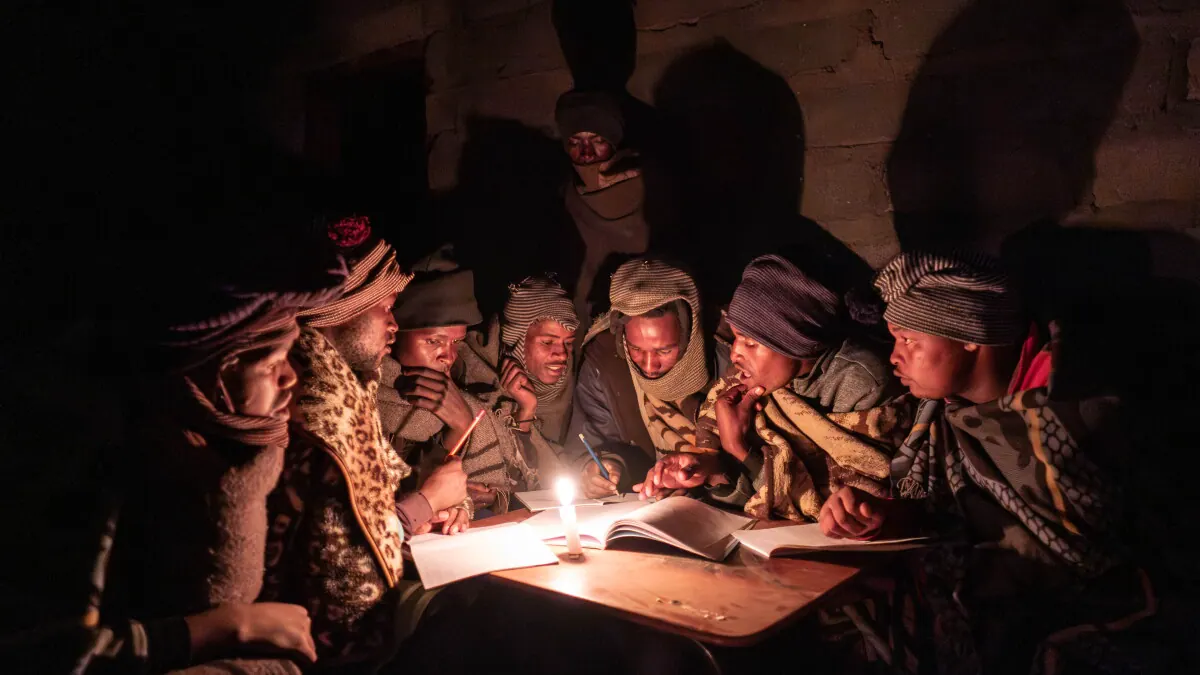
In the mountainous country of Lesotho, a unique educational initiative is providing a second chance at learning for tens of thousands of boys and young men who work as shepherds. The Good Shepherd Night School, located in the small town of Semonkong, is one such institution that has been offering classes to herders every evening for over two decades. The school's students, mostly boys and young men, make their way down from the mountains, braving the cold and darkness, to attend classes that are crucial to their future.
Lesotho's economy and culture are deeply intertwined with livestock, with wool and mohair accounting for nearly 60% of agricultural exports and supporting a quarter of the rural population. However, this comes at a cost, as many school-aged boys are forced to tend to flocks, often spending months at a time herding alone in the mountains, cut off from society. A World Bank analysis of 2018 data found that nearly half of all boys in the country were engaged in some form of herding, with many, like Kabelo Mohai, having to drop out of school to work.
The Good Shepherd Night School was founded in 2003 by the Good Shepherd Sisters of Quebec congregation, who discovered that most boys in Semonkong could not read or write. The school's teacher, Sister Rosemary Mokebe, runs the school and teaches grades 6 and 7, with classes held every weekday evening. The school has over 40 students, ranging in age from 15 to 55, and is one of many night schools that have emerged across the country to provide education to herders.
The night school movement in Lesotho is a significant one, with the government estimating that there are about 155 such schools nationwide. These schools were originally supported by nongovernmental groups but have slowly been taken over by the Ministry of Education, which seeks to formalize the volunteer-run classes and provide stipends to rural educators. However, the process has been hampered by delays and bureaucratic hurdles, with educators' annual contracts yet to be renewed.
For many students, like Motlatsi Monoana, the night school has provided a chance to learn basic skills that they never had the opportunity to acquire earlier in life. Monoana, in his mid-40s, had never been to school until this year, having been forced to look after animals instead. He says he is regularly cheated by employers and cannot read the contracts he signs, but the night school has given him hope that he might eventually find employment outside herding.
The challenges faced by the night schools are significant, with many struggling financially to keep their doors open. The teaching is often basic, with a focus on reading, writing, and counting, but for many students, it is a lifeline to a different future. For Ketso Mokoena, an 18-year-old who started herding part-time at 11 and dropped out of school a few years later, the night school has provided a chance to escape a life of herding and pursue his dreams.
As the night school movement continues to grow in Lesotho, it is clear that the need for education among herders is great. With the government's support, these schools can provide a vital service to thousands of young men and boys, offering them a chance to learn, grow, and pursue their dreams. For Kabelo Mohai and Lepeli Maapesa, who make the long trek down the mountain every evening to attend classes, the night school is a beacon of hope for a brighter future.
Key points
- The Good Shepherd Night School in Lesotho provides education to over 40 herders every evening, offering them a chance to learn basic skills and dream of a different future.
- Lesotho's economy and culture are deeply intertwined with livestock, but this comes at a cost, as many school-aged boys are forced to tend to flocks, often spending months at a time herding alone in the mountains, cut off from society.
- The night school movement in Lesotho is a significant one, with the government estimating that there are about 155 such schools nationwide.