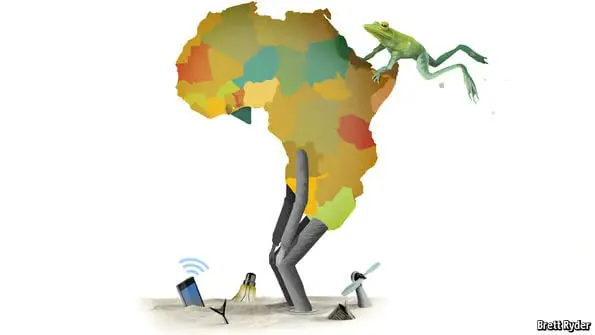
The concept of leapfrogging challenges traditional assumptions about progress and development. It suggests that countries and institutions do not have to follow the same route as others before they can enjoy similar opportunities. Instead, they can bypass some intermediate stages of development and move directly to a more advanced technology or model. This approach is made possible by advancements in technology, which have created new opportunities for countries to leapfrog.
A notable example of leapfrogging is the telecommunications experience in Africa. Many people in Africa did not first acquire a household landline and later replace it with a mobile phone. Instead, they moved directly into mobile communication. The World Bank Group's 2024 report, Digital Opportunities in African Businesses, identifies this as a notable example of leapfrogging. Mobile money has also extended this possibility, allowing people to transact digitally before opening a conventional bank account.
However, leapfrogging does not mean that the machinery behind a service is abolished. Mobile transactions still depend on secure technology, financial institutions, and arrangements that protect customers. Agents who exchange cash for electronic value connect the digital service to everyday life. These agent networks help bring financial services to underserved customers, but they also require effective oversight to protect those who rely on them.
There is an interesting advantage for countries that arrive later. A newer competitor may be able to begin with a more suitable model, avoiding the constraints of older systems. However, being behind is not automatically an advantage. A business without old equipment may also lack finance, skilled workers, and reliable electricity. The opportunity lies in avoiding unnecessary duplication, not celebrating deprivation.
Education provides a particularly powerful illustration of leapfrogging. Digital delivery enables the combination of academic expertise with online platforms and local support, allowing access to expand without a matching expansion of buildings. Thunderbird School of Global Management at Arizona State University offers a concrete example through its Najafi 100 Million Learners Global Initiative, launched in 2022. The initiative provides online learning opportunities in entrepreneurship, business, innovation, and leadership at no cost to learners.
However, a platform is not an education, and a registration is not a learning outcome. UNESCO's work on educational technology emphasizes the importance of access, teacher preparation, and evidence of benefit. The meaningful test is whether learners understand more and can apply what they have learned, not how impressive the delivery system looks. For a Ghanaian entrepreneur, this could mean studying a business concept online and applying it to stock management the following morning.
Ultimately, leapfrogging is not a universal solution, and it is not a replacement for traditional development. A digital marketplace cannot carry tomatoes over an impassable road, and a payment application cannot provide the electricity needed to operate a factory. The ambition is not necessarily education without effort, but useful learning without every obstacle imposed by geography and physical capacity.
Key points
- Leapfrogging allows countries to bypass intermediate stages of development and move directly to more advanced technologies or models.