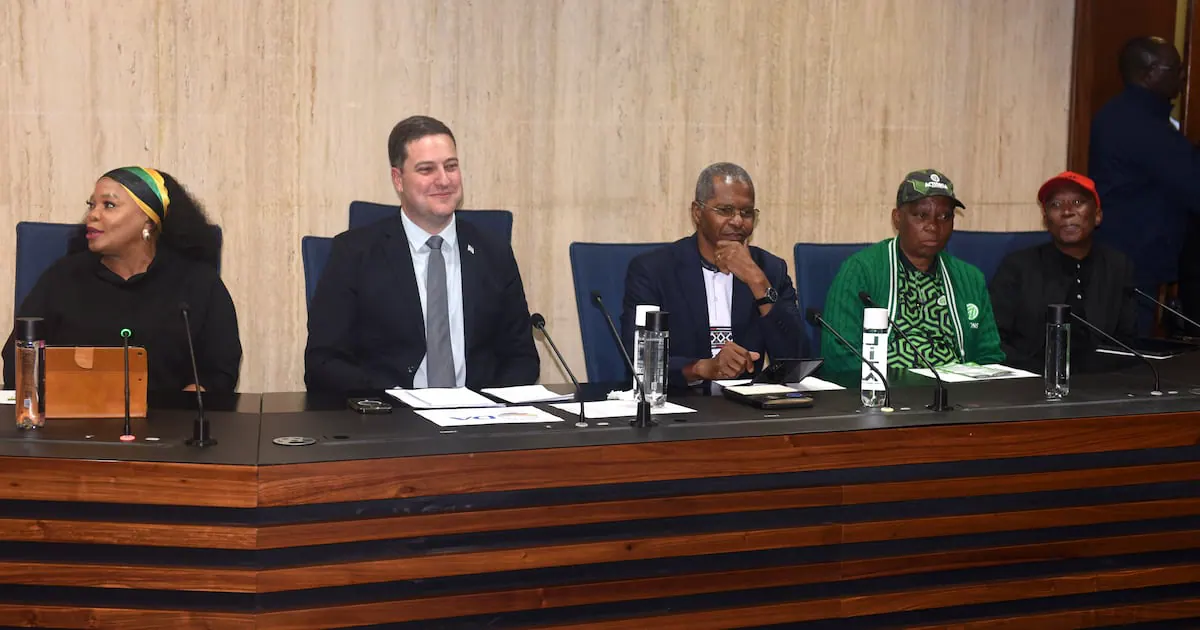
The leaders of South Africa's major political parties, including the ANC, DA, EFF, IFP, and ActionSA, engaged in a heated debate on Thursday over issues affecting the City of Johannesburg. The debate, co-hosted by Business Day, Sowetan, and Sunday Times in partnership with Wits University, focused on corruption, coalition politics, immigration, and service delivery. The city's recent history of unstable coalitions was a major topic of discussion, with parties disagreeing on whether a single-party administration or a different coalition configuration was the solution. Johannesburg, South Africa's economic powerhouse, is set to see a fierce fight for control in the November local government elections.
DA leader Geordin Hill-Lewis accused the ANC of turning Johannesburg into a "failed state" over the past decade and vowed to seek an outright majority to govern the city. He proposed appointing a capable city manager to run the administration, selected based on competence rather than political deployment. Hill-Lewis also praised former DA leader Helen Zille, saying she was capable of turning around the city's fortunes. However, he conceded that coalitions were now a feature of South African politics and urged parties to find common ground.
The debate highlighted significant differences between the EFF and the DA, with EFF leader Julius Malema rejecting Hill-Lewis's characterization of his party as a source of "chaos" in coalition governments. Malema also denied allegations that the EFF had sought tenders from former DA councillor Herman Mashaba during his tenure as Johannesburg mayor. The exchange escalated into a heated argument over the VBS Mutual Bank scandal and the parliamentary findings against former EFF deputy president Floyd Shivambu.
The leaders also clashed over the state of the national economy, with Hill-Lewis defending the Government of National Unity (GNU) and saying economic reforms were starting to improve the economy. Malema disputed this, pointing to weak economic growth as evidence that the GNU was not a success. The debate also exposed differences over immigration and ethnic mobilisation, with Malema arguing that political mobilisation based on ethnicity or race was unsustainable.
IFP leader Velenkosini Hlabisa agreed that ethnic mobilisation was dangerous, but maintained that the IFP remained opposed to undocumented foreign nationals remaining in South Africa. Hlabisa also announced that the IFP would host a roundtable conference on femicide on October 9 and called on other political parties to participate. ActionSA leader Herman Mashaba said illegal immigration was one of several major issues facing Johannesburg, but rejected the idea that his political identity was defined solely by the issue.
Mashaba, who served as Johannesburg mayor from 2016 to 2019, attacked the DA for corruption, saying he had fired three DA MMCs for corruption but the party had refused to remove them as councillors. Mashaba also accused the DA of political manoeuvring against him during his tenure as mayor and raised questions about a tender awarded during his administration. Hill-Lewis did not substantively engage the historical allegations, instead urging Mashaba to concentrate on issues affecting Johannesburg residents.
ANC deputy secretary-general Nomvula Mokonyane defended her party's "renewal" project and its record in Johannesburg, while acknowledging previous shortcomings. She highlighted efforts to fill strategic vacancies, strengthen revenue management, and provide youth employment and economic opportunities. Mokonyane also clashed with Hill-Lewis over housing and spatial inequality, particularly in Cape Town. The city's 2026/27 budget documents show a revised revenue collection rate of 86%, down from 88.6%, with the city identifying ongoing challenges.
Key points
- Johannesburg's recent history of unstable coalitions was a major topic of discussion in the debate.
- The leaders disagreed on whether a single-party administration or a different coalition configuration was the solution to the city's challenges.
- The debate highlighted significant differences between the EFF and the DA, as well as other parties, on issues such as corruption, immigration, and service delivery.