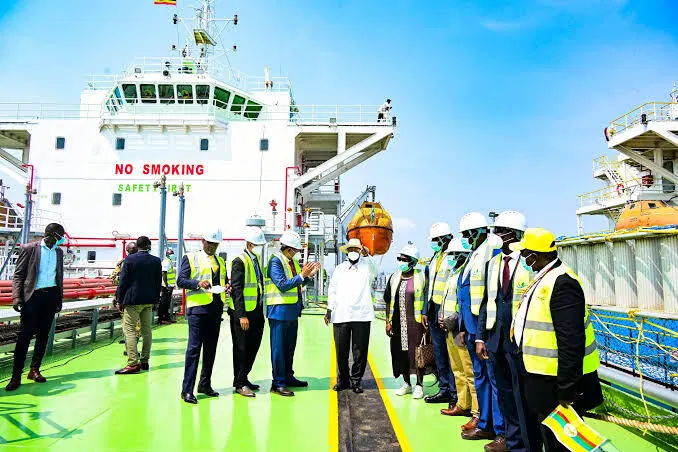
A new analysis has highlighted the strategic importance of the Lake Victoria Fuel Transport Project, a $300 million petroleum transportation and storage complex on Lake Victoria. The project, which transports refined petroleum products from Kisumu in Kenya to its terminal at Kawuku in Uganda, is being positioned as a strategic regional infrastructure investment rather than a purely private commercial undertaking. The complex has vessels, including MT Kabaka Mutebi II and MT Elgon, that can move approximately 4.5 million litres of fuel in a single voyage.
The project has several benefits, including reducing congestion, road deterioration, accident exposure, emissions per unit of cargo, and pressure on border-clearance facilities. Every successful voyage removes a substantial convoy of heavy fuel trucks from the Northern Corridor. This enables Uganda to receive fuel in bulk and build resilience against road closures, political disruptions, accidents, and other emergencies. The project also strengthens the commercial importance of Kisumu Port and supports Uganda's energy security.
The analysis draws comparisons with regulated inland shipping systems in North America, Europe, and Asia. The Great Lakes-St. Lawrence transportation system shared by the United States and Canada is cited as a strong international comparison. Despite the Great Lakes being among the world's most environmentally important freshwater bodies, the two countries have not prohibited commercial shipping, including petroleum products. Instead, they regulate it through stringent vessel standards, crew qualifications, and navigation controls.
The analysis also points to Europe, where the Rhine, Danube, Moselle, Main, Rhone, and connected canal systems regularly carry petroleum products, chemicals, and other dangerous goods under the European Agreement concerning the International Carriage of Dangerous Goods by Inland Waterways. Sweden's Lake Vänern and Lake Mälaren are cited as examples showing that freshwater navigation can remain economically useful while governments maintain demanding environmental standards.
The Caspian Sea, geographically the world's largest enclosed inland body of water, demonstrates the strategic value of inland tanker transportation. Tankers have been moving crude oil and refined products between Kazakhstan, Azerbaijan, Turkmenistan, Russia, and Iran for decades. China's Yangtze River Economic Belt, Pearl River system, and Beijing-Hangzhou Grand Canal are also cited as examples of inland waterways supporting industrial growth.
Mahathi's vessels have double-hull construction and internationally recognised marine safety features. A double hull creates protective separation between cargo tanks and the outer shell, reducing the likelihood of a collision or grounding rupturing a fuel tank. However, the analysis cautions that no vessel should be described as literally "unsinkable" or completely incapable of leaking. Safety comes from multiple layers, including sound vessel design, independent classification, and periodic inspection.
The project must remain subject to environmental approvals and operating conditions administered by the National Environment Management Authority of Uganda and the National Environment Management Authority of Kenya. The analysis argues that East Africa cannot advocate regional integration while failing to use its greatest shared freshwater transport asset. Lake Victoria connects Kenya, Uganda, and Tanzania and lies at the heart of the East African Community.
Key points
- The project is seen as strengthening the commercial importance of Kisumu Port and supporting Uganda's energy security.
- The analysis draws comparisons with regulated inland shipping systems in North America, Europe, and Asia.
- The project must remain subject to environmental approvals and operating conditions administered by relevant authorities.