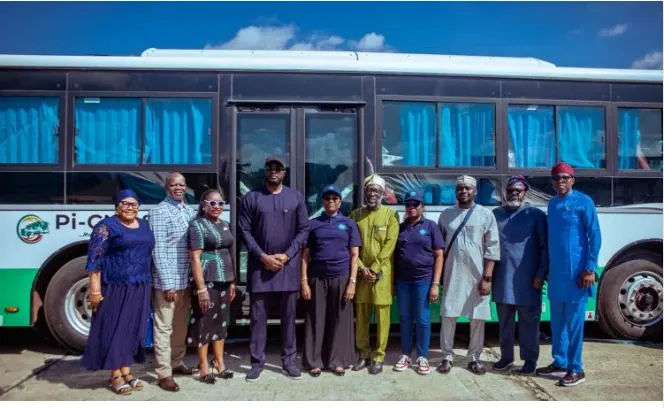
The Lagos State government has taken delivery of 35 buses, comprising 15 compressed natural gas (CNG) buses and 20 electric buses, under the Presidential Initiative on Compressed Natural Gas and Electric Vehicles (Pi-CNG & EV). This development aims to reduce transportation costs and improve public mobility in the state. The buses were handed over to the state Commissioner for Transportation, Oluwaseun Osiyemi, and the Managing Director of the Lagos Metropolitan Area Transport Authority (LAMATA), Abimbola Akinajo.
The Chief Operating Officer of Pi-CNG & EV, Tosin Coker, stated that the deployment was aimed at supporting the Federal Government's efforts to provide cleaner, more efficient, and affordable transportation for Nigerians. He explained that the initiative was not only about increasing the number of buses on the roads but also about expanding transport capacity, lowering operating costs, and ultimately making fares more affordable for commuters.
According to Coker, the sustainability of the programme depends on the availability of adequate infrastructure to support the vehicles. The development came as the Benue State Government announced plans to expand its transport fleet with additional vehicles, including CNG-powered buses, in line with the Federal Government's directive to states to take measures to lower public transportation fares.
The Federal Government's directive to states to take measures to lower public transportation fares is part of efforts to reduce the cost of living and improve the standard of living for Nigerians. The Lagos State government has been working to improve public mobility and reduce transportation costs, and the receipt of the CNG and electric buses is a significant step in this direction.
The 35 buses received by Lagos State are part of a larger effort to promote the use of CNG and electric vehicles in Nigeria. The use of CNG and electric vehicles is expected to reduce the country's dependence on petrol and diesel, which are currently the primary fuels used for transportation in Nigeria.
The Managing Director of LAMATA, Abimbola Akinajo, and the Commissioner for Transportation, Oluwaseun Osiyemi, expressed their gratitude to the Federal Government and Pi-CNG & EV for the buses. They stated that the buses would be used to improve public mobility and reduce transportation costs in the state.
The deployment of the CNG and electric buses in Lagos State is expected to have a positive impact on the environment and the economy. The use of cleaner fuels is expected to reduce greenhouse gas emissions and improve air quality, while the reduction in transportation costs is expected to boost economic activity and improve the standard of living for Nigerians.
Key points
- The Lagos State government receives 35 CNG and electric buses to enhance public mobility and reduce transportation costs.
- The Federal Government's directive to states to lower public transportation fares aims to reduce the cost of living and improve the standard of living for Nigerians.
- The use of CNG and electric vehicles is expected to reduce Nigeria's dependence on petrol and diesel and promote a cleaner environment.