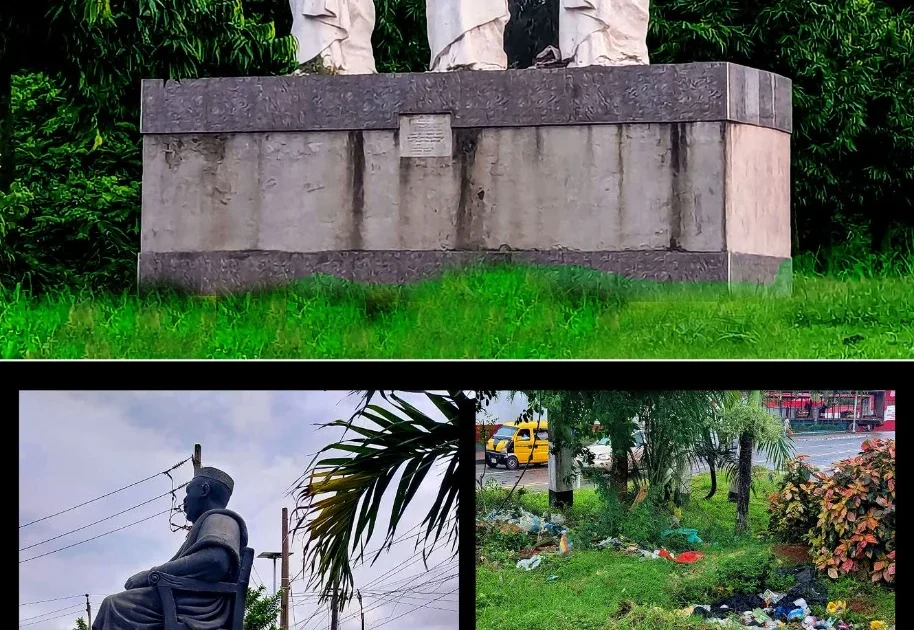
Lagos, a city of over 25 million people, is home to numerous public monuments that have shaped its identity for generations. These monuments, including the Sojà Ìdúmotà cenotaph, the bronze statue of Queen Elizabeth II, and the statues of Herbert Macaulay and Tai Solarin, have anchored the city's identity and served as a narrative of resilience. However, behind their artistic grandeur lies a quiet crisis of systemic neglect and vulnerability.
The monuments are facing numerous challenges, including material erosion, physical displacement, spatial encroachment, vandalism, poor siting, and insufficient policy or quality control governing their creation, installation, and maintenance. The Lagos State Government has been accused of neglecting these public assets, with investigations revealing a massive chasm between the government's declarations and actual physical commitment to maintaining the monuments.
The neglect of these monuments has significant consequences, including the gradual erasure of cultural landmarks, waste of public funds, and threats to human lives. The situation also suggests a poor perception of public art among residents, who do not see it as "theirs" to protect, but rather as government property or an obstacle to economic survival. This perception undermines the purpose of public art and its potential to drive economic revitalization and civic well-being.
The Lagos State Tourism, Arts and Culture has been accused of failing to follow through on its rhetoric about routine quality assessments, public art security details, or structured collaborations with the Lagos State Parks and Gardens Agency. The agency has explained away the filth at the Awolowo monument as a "temporary littering issue," which is under control. However, this has been described as bureaucratic gaslighting, with the site having been littered with refuse for months.
Investigations have revealed that Lagos monuments receive routine maintenance just biannually, leaving multi-million-naira cultural landmarks to battle harsh coastal weather, airborne sea salts, and heavy diesel soot. This has been described as administrative negligence, with the city's coastal-tropical microclimate presenting a uniquely threatening environmental cocktail that degrades outdoor materials at an alarming rate.
The survival of public art in Lagos is dictated by an unrelenting adversary: the city's coastal-tropical microclimate. The city's weather presents a uniquely threatening environmental cocktail, with year-round relative humidity averaging above 80 percent, relentless tropical radiation, daily scorching heat, and torrential seasonal downpours. This, combined with heavy urban particulate pollution, continuously degrades outdoor materials.
To address the neglect and decay of Lagos' public monuments, there is a need for a coherent policy framework, a dedicated budget line, and input from experienced visual art professionals for pre-execution concept assessment, routine conservation, cleaning, and restoration. The Lagos State Government must prioritize the maintenance and conservation of these cultural landmarks to unlock their true value and potential to drive economic revitalization and civic well-being.
Key points
- The neglect of Lagos' public monuments has significant consequences, including the gradual erasure of cultural landmarks, waste of public funds, and threats to human lives.
- The Lagos State Government has been accused of neglecting these public assets, with investigations revealing a massive chasm between the government's declarations and actual physical commitment to maintaining the monuments.
- The city's coastal-tropical microclimate presents a uniquely threatening environmental cocktail that degrades outdoor materials at an alarming rate, making routine maintenance and conservation crucial to the survival of public art in Lagos.