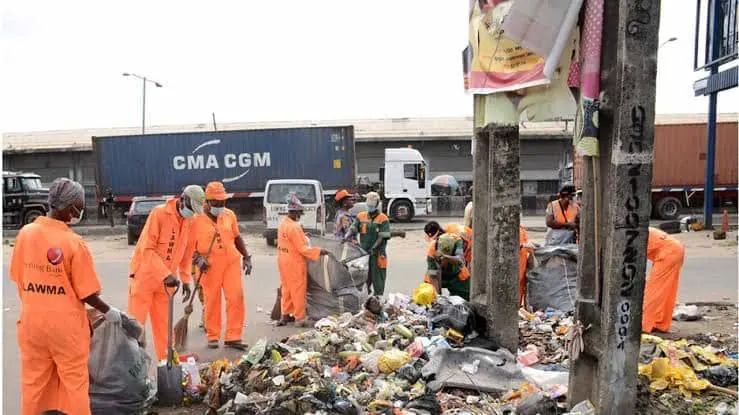
When Babajide Sanwo-Olu took office as Governor of Lagos State on May 29, 2019, he inherited a megacity with significant environmental challenges. Lagos was expanding economically but struggling with environmental degradation, population growth, and inadequate waste management. Thousands of tonnes of refuse entered the waste stream daily, and developments pressed harder against wetlands and waterways. Climate change complicated rainfall patterns, and the city's coastal geography made it vulnerable to the Atlantic, lagoons, rivers, creeks, and tides.
Seven years later, Lagos still faces environmental challenges, including flooding, waste collection breakdowns, and pollution. In June 2026, the Commissioner for Environment and Water Resources, Tokunbo Wahab, publicly apologized for recent evacuation failures and acknowledged poor performance during the preceding months. However, the city has made progress in changing its approach to these problems. The state has adopted a broader philosophy of urban environmental resilience, focusing on drainage, waste management, and climate change.
The numbers demonstrate Lagos' commitment to environmental improvement. In 2025, the state reported that 12 primary drainage channels covering 32.5 kilometres had been restored, while 84 secondary channels totalling 96 kilometres were restored in 2024. The government also reported the removal of 1,141 contraventions affecting drainage rights of way. In June 2026, Sanwo-Olu approved dredging and maintenance of an additional 28 primary drainage channels.
Waste management has also undergone a significant shift. For decades, Lagos operated a linear model, collecting waste and taking it somewhere else. However, the Lagos Climate Adaptation and Resilience Plan proposes waste conversion and treatment as part of the longer-term response. The state is moving towards a circular economy, where plastic is recycled, organic material becomes compost, and recovered materials return to manufacturing.
Climate policy has become more structured, with the Lagos Climate Adaptation and Resilience Plan identifying sea-level rise, extreme rainfall, and extreme heat as major climate-impact drivers. The plan lays out 33 adaptation projects around infrastructure, communities, and crisis response. In August 2026, Lagos introduced a Climate Defence and Catalytic Fund to attract private investment into climate-resilient and low-carbon projects.
Urban greening is another area of focus, with LASPARK reporting that 13,401 trees had been planted towards an annual target of 20,000 by June 30, 2026. The trees are geo-tagged, and local councils are involved in their subsequent care. Environmental enforcement has also been a priority, with properties affected, structures coming down, and businesses sealed for noise and pollution violations.
Despite progress, there are still shortcomings, including the need for improvement in primary waste collection, environmental data accessibility, and planning and environmental approvals integration. However, a legacy need not mean perfection; sometimes, it is a change in direction. Seven years after 2019, there is a discernible attempt to move Lagos from reactive environmental sanitation towards integrated environmental management.
Key points
- Lagos has shifted from reactive sanitation to integrated environmental management.
- The state has made progress in drainage restoration, waste management, and climate policy.
- Urban greening and environmental enforcement have also been prioritized.