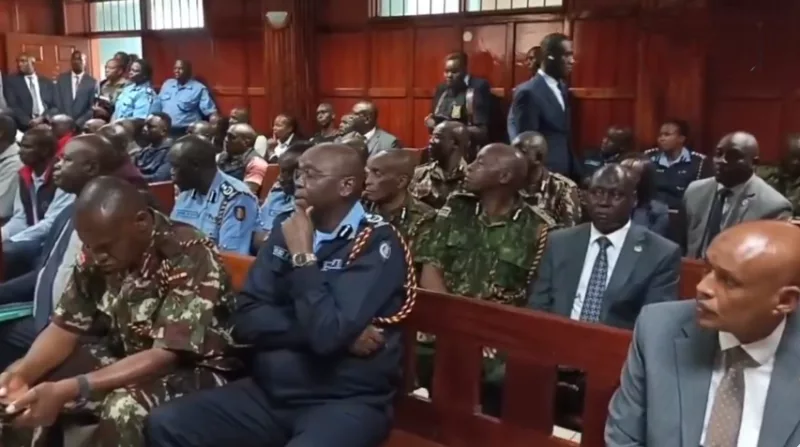
Senior National Police Service officers, including Kenya Police Service Deputy Inspector General Eliud Lagat and Directorate of Criminal Investigations Director Mohamed Amin, accompanied Inspector General of Police Douglas Kanja to the High Court in Nairobi for mitigation and sentencing. Kanja was found in contempt of court over unannounced roadblocks erected during the June 25 protests. The court proceedings arose from a case filed by Katiba Institute over police restrictions imposed in Nairobi during the commemoration of the Gen Z-led anti-Finance Bill protests.
The contempt proceedings followed a September 17 ruling by Justice Patricia Nyaundi, who found Kanja personally responsible for failing to ensure that officers under his command complied with a court order governing the erection of roadblocks and barricades. The court had issued conservatory orders on July 9, 2025, requiring the Inspector General and officers under his command to issue timely advisories before emergency barricading of roads. The order allowed members of the public to plan their activities accordingly.
The case filed by Katiba Institute challenged the erection of roadblocks and barricades on major roads leading into the Nairobi Central Business District. The rights organisation argued that police had failed to issue the advance public advisory required by an existing court order. Justice Nyaundi found that the police had mounted emergency roadblocks and barricades without giving members of the public timely notice.
Kanja had denied wilful disobedience, with the police arguing that the contempt application was misconceived and that there was no evidence that the Inspector General personally authorised the specific roadblocks. The police also argued that the June 25 demonstrations were unlawful and that officers had acted within their mandate to prevent disorder. However, the court found that the absence of the required public advisory amounted to non-compliance with the order.
The ruling placed personal responsibility on the Inspector General for ensuring that officers under his command complied with the binding court order. Justice Nyaundi rejected the argument that the roadblocks were spontaneous responses to security threats and that police action could therefore be exempted from the requirement to issue an advisory. The court found that the police had prior knowledge of the planned demonstrations and that no advisory was issued before the roads were barricaded.
Monday's appearance marked the next stage of the proceedings, with the court considering Kanja's mitigation before determining the sentence for the contempt finding. The court will consider Kanja's arguments and determine an appropriate sentence for the contempt of court. The outcome of the case will have implications for the National Police Service and its operations.
The case highlights the importance of police compliance with court orders and the need for transparency in their operations. The court's decision will be a significant development in the ongoing debate about police accountability and the rule of law in Kenya. Key issues at stake include the balance between police powers and individual rights, and the extent to which police can restrict public gatherings and movement.
Key points
- Inspector General of Police Douglas Kanja was accompanied by senior police officers to court for mitigation and sentencing.
- Kanja was found in contempt of court over unannounced roadblocks erected during the June 25 protests.
- The court's decision will have implications for the National Police Service and its operations.