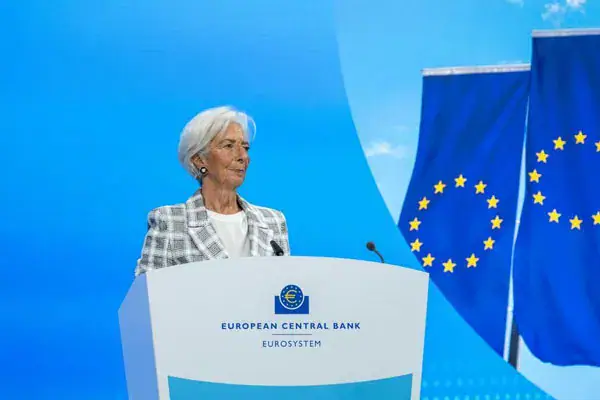
European Central Bank President Christine Lagarde has announced that she will step down on February 7, 2027, nearly nine months before the scheduled end of her eight-year term. Lagarde, 70, has led the ECB since November 2019, overseeing a series of crises including the COVID-19 pandemic, the Russia-Ukraine conflict, and record-high inflation. Her tenure has been marked by significant monetary policy decisions, including the launch of an emergency asset purchase program and an aggressive tightening cycle.
Lagarde's decision to leave the ECB early has raised questions about the implications for the eurozone's monetary policy outlook. The eurozone is currently facing renewed inflationary pressures, mounting fiscal strains, and growing political uncertainty ahead of France's 2027 presidential election. French President Emmanuel Macron praised Lagarde's leadership and called for an orderly and balanced process to choose her successor. The ECB's independence has been emphasized, but Lagarde's early exit has brought concerns about the bank's ability to remain impartial.
Lagarde stated that she wanted greater freedom to speak and engage on public issues beyond monetary policy, citing the need for the ECB's president to remain politically neutral. However, the timing of her departure has sparked speculation about its potential impact on the French presidential election. German public broadcaster ARD reported that Lagarde's early exit would allow Macron, German Chancellor Friedrich Merz, and other European leaders to agree on her successor before the vote.
The contest for Lagarde's position has begun, with several candidates emerging as potential successors. Former Dutch central bank governor Klaas Knot and Pablo Hernandez de Cos, the former Spanish central bank chief, are widely seen as leading contenders. European Investment Bank President Nadia Calvino, a former Spanish economy minister, has also been mentioned as a possible candidate. The next ECB president will inherit a difficult economic environment, with rising energy prices adding to inflation risks and weighing on growth.
The ECB's monetary policy strategy has been subject to review during Lagarde's tenure, and her successor will need to navigate a complex economic landscape. The bank has kept its interest rates unchanged, leaving the deposit rate at 2.5 percent after two increases this year. However, policymakers face a difficult trade-off between containing inflation and supporting economic growth. Fiscal pressures in some member states, including France, add another challenge.
Economists have weighed in on the potential implications of Lagarde's departure, with some welcoming the decision as a way to ensure a smooth transition. Marcel Fratzscher, head of the German Institute for Economic Research, said Lagarde had shown a strong sense of responsibility towards Europe and the ECB. Clemens Fuest, president of the Munich-based ifo Institute, also supported the decision, warning of the risks of radical candidates winning the French presidential election.
The leadership change at the ECB is unlikely to bring major shifts in monetary policy, according to Holger Schmieding, chief economist at Berenberg. He noted that key decisions were typically reached by consensus in the Governing Council rather than made by the president alone. Lagarde's successor will need to contain renewed inflationary pressures without further weakening growth, while safeguarding the ECB's independence amid Europe's shifting political landscape.
Key points
- Lagarde's early exit from the ECB has raised questions about the bank's independence and the implications for eurozone monetary policy.
- The contest for Lagarde's position has begun, with several candidates emerging as potential successors.
- The next ECB president will inherit a difficult economic environment, with rising energy prices adding to inflation risks and weighing on growth.