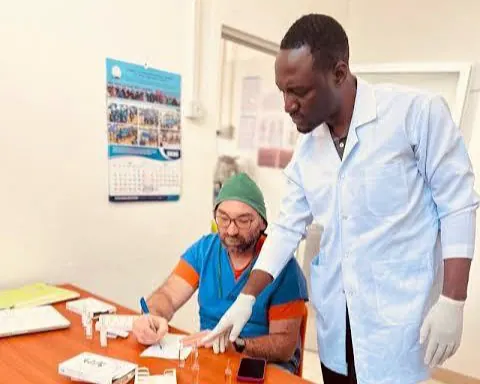
For many women, the excitement of meeting a newborn is accompanied by another thought: the pain of labour. As contractions intensify and the baby moves through the birth canal, discomfort can become severe. Medical advances are giving women options for managing labour pain. One such option is epidural analgesia, which reduces pain while allowing a mother to remain awake, feel pressure, and participate actively in childbirth. This method is being introduced at Benjamin Mkapa Hospital (BMH) in Dodoma, Tanzania.
Specialist anaesthesiologist Dr Lugano Wilson explained that epidural analgesia does not stop labour, but blocks pain signals from reaching the brain. The mother continues to experience contractions, feel pressure, and sense the baby's descent, but the pain information that normally reaches the brain is blocked. This allows women to respond to health workers' instructions to push while the baby continues to descend normally. The procedure typically starts after labour has begun and the cervix has reached about four centimetres of dilation, with its effect beginning within 10 to 20 minutes after medication is administered.
The World Health Organisation (WHO) recommends epidural analgesia for healthy pregnant women requesting pain relief. However, access to this service remains uneven. A WHO Multicountry Survey on Maternal and Newborn Health found that among 221,345 women who had vaginal births, only four per cent received labour analgesia, with epidural being the main form recorded. The use of epidural analgesia is higher in countries with higher Human Development Index levels and lower in lower-HDI settings.
Dr Wilson noted that epidural services are more available in countries with accessible resources and specialist anaesthesia services, such as the United States, Finland, France, and the United Kingdom. In Africa, the use of epidural analgesia remains less widespread. Expanding access to this service is not about changing the natural process of childbirth but reducing unnecessary suffering. Severe pain can cause psychological distress and make it harder for a woman to concentrate on instructions from health workers.
Severe pain and fatigue can become overwhelming, leading some women to request Caesarean delivery. WHO's evidence review identifies epidural analgesia as an effective option for labour pain relief, finding moderate-certainty evidence that it probably results in fewer Caesarean births than no epidural. However, WHO notes uncertainty around some other outcomes and says epidural requires more resources and monitoring than opioid analgesia.
Despite its benefits, epidural analgesia is not suitable for every woman. At BMH, women are assessed before the procedure at a specialised clinic where expectant mothers can receive information, ask questions, and undergo assessment. Dr Wilson encourages women to attend from around 32 weeks of pregnancy to understand the service, discuss concerns, and make plans before labour begins. Women with certain medical conditions, such as blood-clotting problems, may not be candidates for epidural analgesia.
The hospital has set a target of having 100 mothers deliver using epidural pain control during the planned period. Dr Wilson emphasised the importance of informed choice, stating that women should understand that labour pain can be managed through different approaches and should be able to discuss available options with qualified health professionals. The central issue is providing women with options for managing labour pain, and BMH's experience represents a step towards increasing access to this service in Tanzania.
Key points
- Epidural analgesia is being introduced as an option for women having vaginal births at Benjamin Mkapa Hospital in Dodoma, Tanzania.
- The World Health Organisation recommends epidural analgesia for healthy pregnant women requesting pain relief.
- Access to epidural analgesia remains uneven, with lower usage in lower-resource settings.