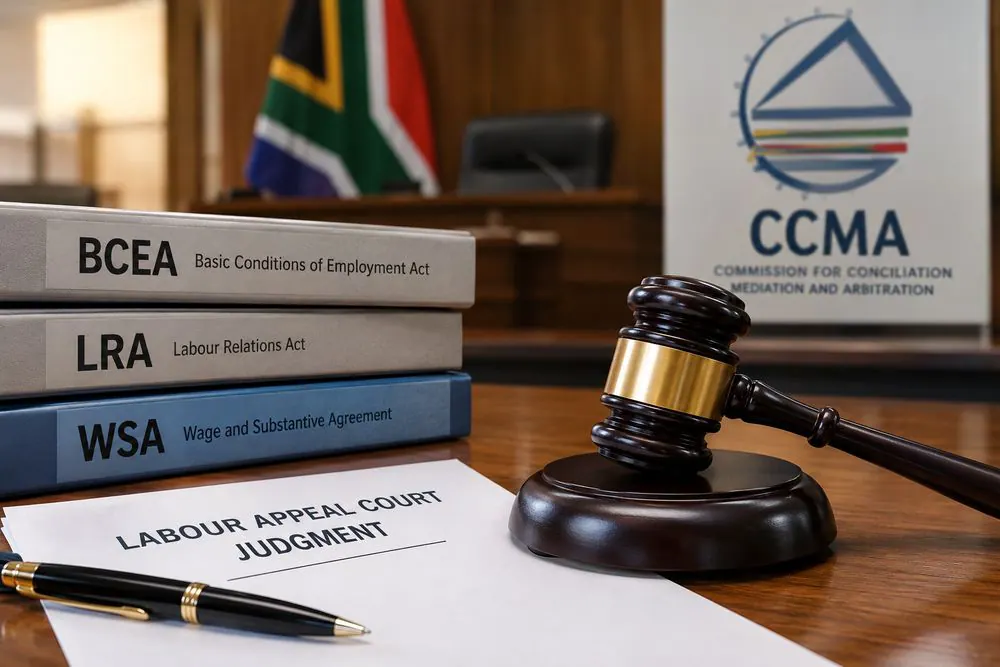
The Labour Appeal Court of South Africa has overturned a ruling that ordered the Commission for Conciliation, Mediation and Arbitration (CCMA) to pay a former commissioner, SN, over R176,000 in salary arrears. The court found that the Labour Court had wrongly treated a collective agreement as the contractual basis for SN's remuneration claim. SN had challenged his salary after transitioning from a part-time to a full-time commissioner.
SN was appointed as a part-time Level B commissioner in July 2017 and later became a full-time commissioner in December 2020. He was placed on an annual package of over R615,000, equivalent to over R51,000 a month at the P7 level. However, he disputed the remuneration from the beginning, claiming he should have been placed at the P6 level or maintained his previous earnings as a part-time commissioner.
The Labour Court had upheld SN's alternative claim, finding that the CCMA's Wage and Substantive Agreement (WSA) applied to him and entitled him to remuneration at the 80th percentile of the P6 level. The court ordered the CCMA to pay him R176,174.32 in salary arrears. However, the CCMA appealed the finding, arguing that the Labour Court had erred in its decision.
The Labour Appeal Court found that the Labour Court had not identified the contractual source of SN's alleged entitlement to P6 remuneration. The court noted that remuneration is an essential term of an employment contract and that SN had expressly rejected the remuneration offered by the CCMA. The appeal court stressed that the Labour Court should have determined whether the parties had reached an agreement on the remuneration obligation before deciding on SN's salary.
The Labour Appeal Court also found that the Labour Court had conflated two different legal jurisdictions. SN had pursued his case as a contractual claim under section 77(3) of the Basic Conditions of Employment Act (BCEA). However, the Labour Court had determined that the WSA applied to him, interpreted its provisions, and used that interpretation to establish his entitlement to P6 remuneration. The appeal court argued that this was a dispute concerning the interpretation and application of a collective agreement, which falls under section 24 of the Labour Relations Act (LRA).
The Labour Appeal Court further found that the WSA was a collective bargaining instrument and not, without more, a term of SN's individual employment contract. The court stressed that the critical question was whether SN had established a contractual right, enforceable under section 77(3) of the BCEA, to remuneration at the level he claimed. The court found that the Labour Court had not explained how the WSA had become incorporated into SN's employment contract or how it created the specific contractual entitlement he sought.
The Labour Appeal Court concluded that the Labour Court had materially misdirected itself by granting relief on a legal basis that was not supported by the cause of action pleaded by SN. The court upheld the CCMA's appeal and set aside the Labour Court's order.
Key points
- The Labour Appeal Court overturned a ruling that ordered the CCMA to pay a former commissioner over R176,000 in salary arrears.
- The court found that the Labour Court had wrongly treated a collective agreement as the contractual basis for the commissioner's remuneration claim.
- The decision highlights the importance of distinguishing between contractual disputes and collective agreement disputes under South African labour law.