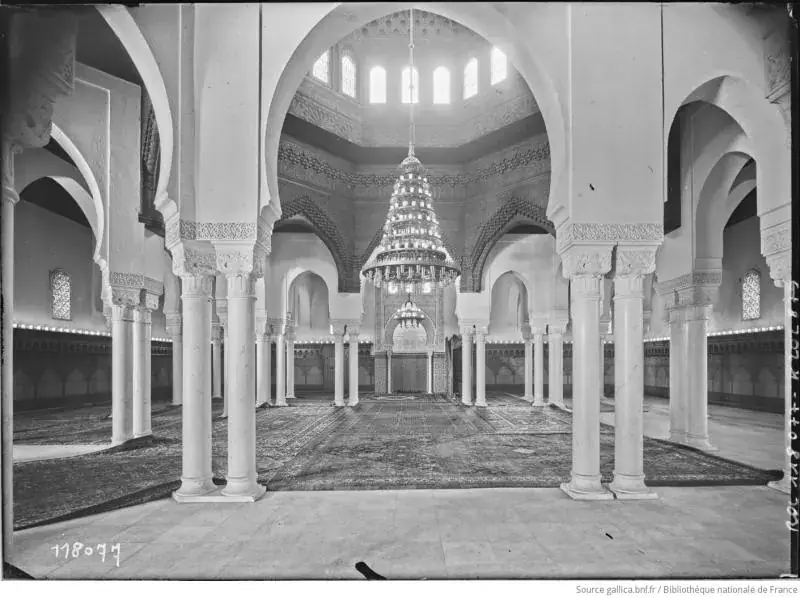
The Grand Mosque of Paris is celebrating its 100th anniversary, having been inaugurated on July 16, 1926. The mosque was built to represent the ties of friendship and peace between France and Muslim peoples. At the time of its construction, France was the second colonial power after the British Empire. The idea of building a mosque in Paris was not new, with projects dating back to the 1840s.
In 1856, a Muslim section was designated in the Père-Lachaise cemetery, as a tribute from Napoleon III to the Ottomans for their participation in the Crimean War. In 1895, the press reported on a new mosque project envisaged by the French Africa Committee. However, many newspapers expressed doubts about the necessity of such a building in France. The Croix newspaper was strongly opposed, questioning the use of funds for the mosque when they could be used for more practical purposes.
Despite initial setbacks, the idea of a symbol of French-Muslim friendship continued to grow. The newspaper La jeune Turquie supported the project, arguing that a mosque would be a welcoming gesture to Muslim visitors and residents in Paris. The author, Albert Lecointre, believed that a mosque would not be a threat to French values and would instead promote understanding and tolerance. He also pointed out that Muslims visiting or living in Paris would appreciate a place of worship.
In 1921, the French government authorized a subsidy for the construction of a Muslim Institute, which would include a mosque, library, and study hall. To circumvent the 1905 law on secularism, the project was entrusted to the Société des habous, an institution based in Algeria. Khaddour Ben Ghabrit, a high-ranking official at the Ministry of Foreign Affairs, directed the project and decided on its orientation. He envisioned a complex that would occupy a 5,000-square-meter site and feature a mosque, hotel, restaurant, and baths.
The construction of the mosque was not without controversy. Some newspapers, such as Le Temps, questioned the necessity of the project, arguing that it would not have a significant impact on the lives of Muslims in the colonies. Others, like L'Humanité, criticized the project as a tool of French imperialism, aimed at co-opting Muslim leaders and promoting French interests. The newspaper also highlighted the exploitation of North African workers involved in the construction.
The Grand Mosque of Paris was eventually built with the help of architects and artists from France and North Africa. The complex was designed to be a symbol of French-Muslim friendship and a gesture of goodwill towards Muslim communities. Today, the mosque remains an important landmark in Paris and a testament to the complex history of French-Muslim relations. It continues to serve as a place of worship and a cultural center for the Muslim community in France.
As the Grand Mosque of Paris celebrates its centennial anniversary, it serves as a reminder of the long history of French-Muslim relations and the complexities of colonialism and cultural exchange. The mosque's construction was a product of its time, reflecting both the ambitions of French colonialism and the desire for cultural understanding and exchange. Today, it remains an important symbol of the complex and multifaceted nature of French-Muslim relations.
Key points
- The Grand Mosque of Paris was inaugurated on July 16, 1926, as a symbol of friendship and peace between France and Muslim communities.