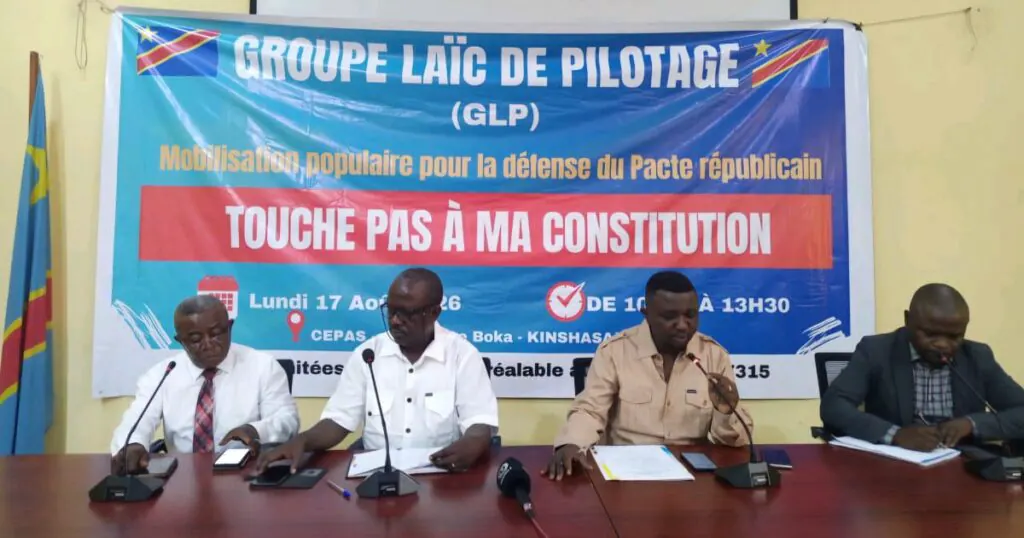
The Group of Catholic Laymen (GLP) has rejected President Felix Tshisekedi's proposed national dialogue, citing concerns over the process's legitimacy and potential for constitutional change. In a statement released on September 18, 2026, the GLP described the dialogue as a "constitutional forfaiture" aimed at extending Tshisekedi's mandate beyond 2028. The group argues that the dialogue is an instrument for revising the constitution to allow for a third term.
The GLP's objections to the dialogue are threefold. Firstly, they argue that the process is being used to push through a constitutional revision favorable to Tshisekedi. This concern is shared by the Coalition for the Defense of Article 64 (C64), which has also denounced the dialogue as an attempt to bypass inclusive consultations. Secondly, the GLP criticizes the exclusion of certain groups, particularly those in the occupied territories of the Grand Kivu region.
The GLP also disputes the "preliminary consultations" required before the dialogue, which they see as a political maneuver to create the illusion that the people demanded this format. Instead, the group argues that the people's aspirations are focused on "peace, security, and good governance for well-being." The GLP's rejection of the dialogue is based on principled concerns, as they believe it threatens the Pact of Sun City and the 2006 Constitution.
The GLP's statement comes after a march organized by the C64 on September 15, which aimed to mobilize against any constitutional revision project. The group plans to release a report on human rights violations during the march. In response to what they see as authoritarian tendencies, the GLP is calling for a general mobilization of the Congolese people to demand the withdrawal of the referendum bill and an inclusive dialogue facilitated by the African Union.
The GLP is demanding a dialogue mediated by the National Episcopal Conference of Congo (CENCO) and the Church of Christ in Congo (ECC), which they believe would guarantee the process's inclusivity and credibility. This call for external mediation is seen as necessary to counterbalance the perceived bias in the current process. The GLP's opposition to the dialogue has added to the growing controversy surrounding Tshisekedi's plans.
The Congolese government has been facing criticism from various groups over its handling of the dialogue process. The C64 and other opposition groups have expressed concerns over the potential for constitutional change and the exclusion of certain groups. The GLP's rejection of the dialogue has further complicated the situation, with the group calling for a united front against any attempts to alter the constitution.
The situation remains tense in the Democratic Republic of Congo, with various groups mobilizing against the government's plans. The GLP's call for a general mobilization has added to the pressure on the government to reconsider its approach. The international community is watching closely, with the African Union and other regional organizations expected to play a role in mediating the crisis.
Key points
- Catholic laymen reject President Felix Tshisekedi's national dialogue over concerns of constitutional change and exclusion.
- The Group of Catholic Laymen (GLP) sees the dialogue as a threat to the Pact of Sun City and the 2006 Constitution.
- The GLP is demanding a dialogue mediated by the National Episcopal Conference of Congo (CENCO) and the Church of Christ in Congo (ECC).