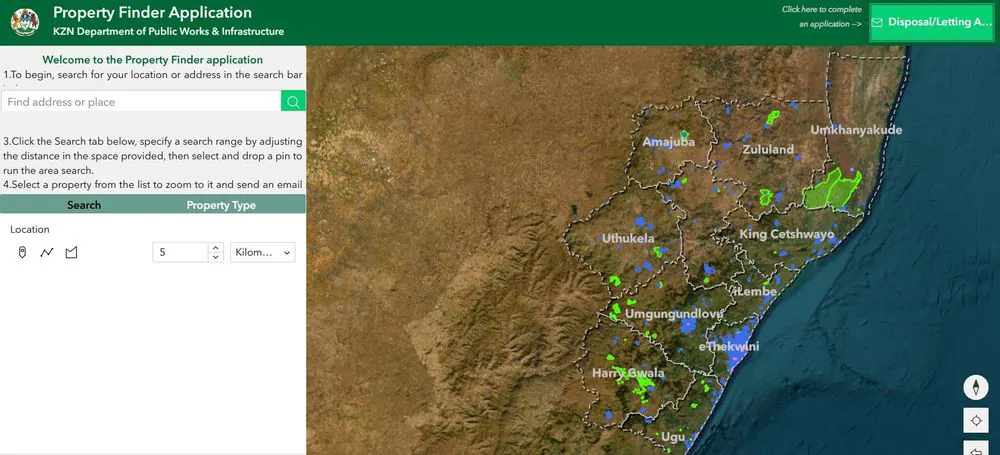
The KwaZulu-Natal province in South Africa has introduced a Property Finder portal, a digital tool that maps 10 067 state-owned properties across the region. This initiative aims to unlock unused government assets, prevent illegal occupations, and provide the public with a direct line to report suspicious activity on state-owned land and buildings. The portal was launched by Public Works and Infrastructure MEC Martin Meyer and Trade, Industry and Competition Deputy Minister John Steenhuisen.
The Property Finder portal was developed in-house and integrated with GIS spatial mapping, allowing citizens, businesses, and NGOs to identify unused government assets for acquisition, leasing, or repurposing. The platform promotes transparency, drives regional economic opportunities, and enables communities to report suspicious activity and suspected unlawful occupations on state property in real-time. This allows authorities to intervene quickly before long-term illegal occupations take root.
The launch of the portal follows an audit of 10 067 state assets, with 81 unused properties already released. The portal transitions the province away from legacy, paper-heavy, and manual inquiry methods toward a transparent, map-based digital ecosystem. Users can access the portal via the departmental website and utilize key features such as submitting maintenance complaints, verifying KZN DPWI-owned land and buildings, checking occupancy status, identifying property types, and applying to use available properties.
According to MEC Martin Meyer, the portal will enable faster building repairs, full asset transparency, reduced illegal occupation, and private sector proposals for unused properties. He emphasized that the portal will also assist in alerting the department when there is sudden activity in an empty, unutilized property. Meyer stressed that time is of the essence when it comes to the hijacking of a building or illegal occupation.
The MEC highlighted that the portal is part of their strategy to reduce their R1.8 billion rates footprint. He stated that the department cannot pay such a large amount in rates and aims to partner with people to make properties economically viable. This can be achieved through partnerships with NGOs, NPOs, or private sector entities that can utilize the properties and reduce the department's rates burden.
KZN DPWI head of department Dr Vish Govender explained that there is a misconception that most of their buildings are hijacked. He emphasized that the portal will help them have real-time access to buildings and enable real-time reporting to prevent illegal occupations. Govender stressed that buildings are often hijacked quickly, and the portal will help the department stay on top of these incidents.
The portal aims to curb illegal occupation of state property and reduce the rates footprint. Key features of the portal include real-time reporting and integration with ward communities, councillors, municipalities, and government. The department aims to adjust the current payment under R751 million to near R900 million for the current budget.
Key points
- The KwaZulu-Natal province has launched a Property Finder portal to map 10 067 state-owned properties.
- The portal aims to unlock unused government assets, curb illegal occupations, and promote transparency.
- The department aims to reduce its R1.8 billion rates footprint through partnerships and economic viability.