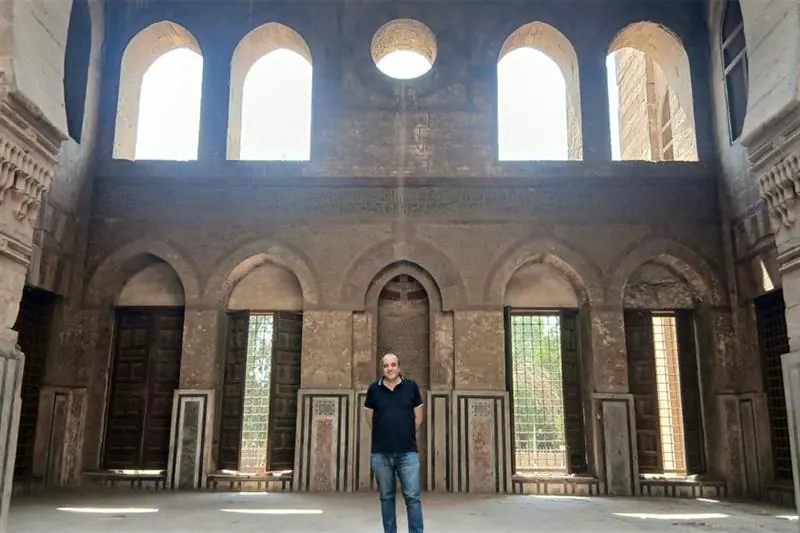
In the heart of the Mamluk Desert lies a large architectural landmark that will soon reopen as part of a community-focused development project. The complex includes a mosque, madrasa, kuttab, and a large courtyard. This is the complex of Prince Korkomaz, whose name means "the fearless" in Turkish. The complex was built between 1505 and 1506 AD and has stood the test of time, featuring arabesque facades, intricately carved wooden ceiling, and tall arched windows.
According to Mohamed Abu Samra, an urban development expert and head of the Board of Trustees of the TAKAMOL Foundation for Integrated and Sustainable Development, Prince Korkomaz was the last of the princes of the army during the reign of Qonsowa Al Ghoury. The TAKAMOL Foundation chose to revive the site and its surrounding area because of its unique spacious courtyard and accessibility. The Mamluks used to call this area Mamalik Sahara and used it as a playground for games and training.
The TAKAMOL Foundation received approval to work on the site in 2020, but the COVID-19 pandemic delayed the project. Since then, the foundation has given many lectures and organized field trips with various universities to visit the site and make students aware of its potential. Abu Samra is also a founding member of the AMAKEN Place-Making Network for Arab States and chairperson of the Egyptian Chapter of the AMAKEN Association for Urban Development.
The population of the Mamluk Desert area is estimated at 24,000 people. In 2023, TAKAMOL and AMAKEN Placemaking collaborated with international expert James Stickley on a workshop for the development of the area, focusing on resilience, integration into the city, and addressing climate change. The collaboration aimed to develop ideas for a holistic approach that integrates local residents.
Between 2024 and 2026, TAKAMOL and AMAKEN collaborated with local universities, institutions, and engineering syndicates on workshops, lectures, presentations, and walks, while also making the site a case study in university curricula. The goal is to turn the courtyard into a bazaar where local craftsmen can display their work, including blown glass, leather, and copper, alongside workshops and human development courses for local residents, especially women.
The development project also aims to revive some of the games of the Mamluks, which were played in the area when it was used as a playground. The project plans to integrate local residents and provide them with opportunities for social and economic development. The site is part of the intangible cultural heritage of Historic Cairo and remains vibrant with residents.
The revival of the Korkomaz complex is part of a larger effort to preserve and develop the cultural heritage of Egypt. The project is expected to have a positive impact on the local community and contribute to the preservation of the country's rich history. The complex is a significant landmark in the City of the Dead, an area that forms part of the intangible cultural heritage of Historic Cairo.
Key points
- The TAKAMOL Foundation aims to turn the courtyard into a bazaar for local craftsmen and provide workshops and human development courses for local residents.
- The complex was built between 1505 and 1506 AD and features arabesque facades, intricately carved wooden ceiling, and tall arched windows.
- The population of the Mamluk Desert area is estimated at 24,000 people.