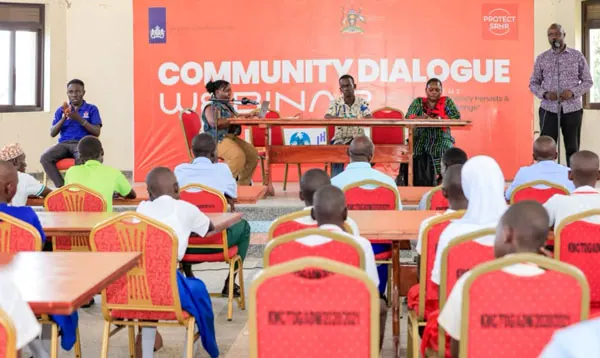
Learners in Koboko District, Uganda, have urged the government and development partners to prioritize access to free sanitary pads for girls. They argue that menstrual hygiene support is critical in keeping girls in school and reducing vulnerabilities that contribute to teenage pregnancies. According to the learners, access to free sanitary pads addresses an everyday challenge faced by girls, as menstruation is a biological process that girls cannot choose.
The call for free sanitary pads was made during a community dialogue webinar organized under the Protect SRHR Project by a consortium of organizations, including International Rescue Committee, World Vision, Reach A Hand Africa, and Humanity & Inclusion, with support from the Embassy of the Kingdom of the Netherlands. The webinar, held on September 29, 2026, brought together learners, teachers, community stakeholders, and partners to discuss the drivers of teenage pregnancies and identify solutions to improve adolescent sexual and reproductive health outcomes.
The engagement was part of the "Link. Learn. Act" monthly webinar series, which brings together stakeholders from different African countries to share experiences and learn approaches being used to address teenage pregnancies. Benson Muhindo, Director of Programmes at Reach A Hand Africa, said the webinar series aims to benchmark how different countries are addressing the challenge of teenage pregnancy.
For many girls, menstrual hygiene remains closely linked to education, confidence, and vulnerability. Lack of access to sanitary products can affect school attendance, participation, and self-esteem, while some girls may be pushed into risky situations in an attempt to meet basic needs. Patience Fatima, a senior three student from Nyarilo Secondary School in Koboko, emphasized that providing free sanitary pads would reduce the pressure that forces some girls into situations where they may engage in risky relationships to access necessities.
The learners also commended the Protect SRHR consortium for creating spaces where young people can openly discuss challenges affecting their lives and receive guidance on making informed decisions. Ayikoru Sumaya, a student from Nyarilo Secondary School, said the dialogue helped young people understand the importance of making decisions that protect their future.
Senior Woman Teacher Ayikoru Gladys from Ombachi Self Help Primary School emphasized that addressing teenage pregnancy requires collective responsibility from parents, teachers, communities, and leaders. She noted that lack of support at home, especially when girls need sanitary pads, can contribute to school dropout.
Meanwhile, Muhindo said Uganda's teenage pregnancy challenge requires continuous reflection and learning from different stakeholders. He appreciated the role of government institutions, including the Ministry of Health, Ministry of Education, and Ministry of Gender, in supporting conversations around teenage pregnancy prevention and response.
Key points
- The learners in Koboko District are calling for free sanitary pads to address the challenges faced by girls during menstruation.
- The Protect SRHR Project aims to improve adolescent sexual and reproductive health outcomes through community dialogue and engagement.
- Addressing teenage pregnancy in Uganda requires a collective effort from parents, teachers, communities, and leaders.