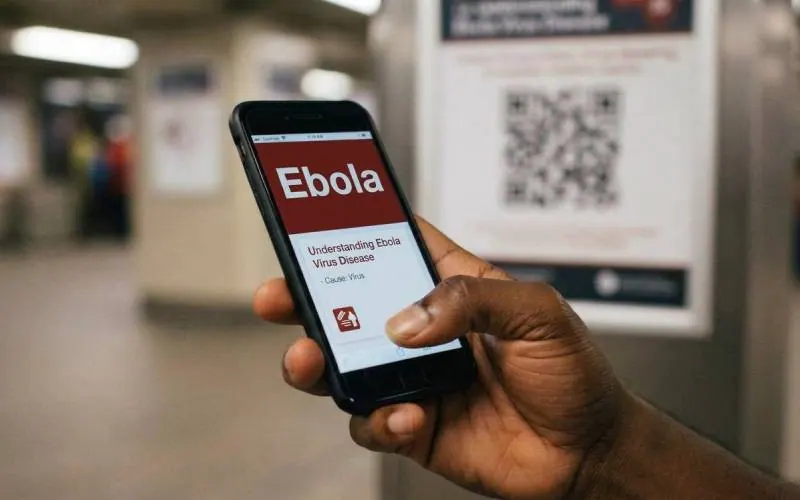
Kenya's Ebola preparedness is facing fresh scrutiny over the use of QR-code health screening at points of entry. A traveller arriving from the Democratic Republic of Congo said she was not required to scan a QR code on arrival. The traveller, who spoke on condition of anonymity, said she encountered stationary temperature checks but no visible QR-code screening process at Jomo Kenyatta International Airport.
The traveller said she encountered a different system while travelling through the DRC and Ethiopia, where QR codes formed part of the health-screening process. She said she expected heightened vigilance when arriving from the DRC because of the ongoing Ebola outbreak. The traveller asked authorities at Jomo Kenyatta International Airport whether passengers were required to scan a QR code after arrival, and was told it was not necessary.
The traveller's account raises questions about the effectiveness of Kenya's Ebola screening system. She described QR-code notices at other airports, including codes displayed on banners and made available to passengers during flights. However, she said she found the Kenyan process noticeably different, with no QR-code screening in place. The traveller believes the change may have occurred in recent weeks.
The Standard tested the digital health-screening process through Uhai, an AI-powered health assistant designed to provide information and guidance on Ebola. Uhai introduces itself as an AI assistant that can provide information on Ebola symptoms, prevention, transmission, care guidance, nearby facilities, and helpline numbers. However, the system's design raises questions about how it screens travellers and captures relevant information.
The Uhai system asks users to agree to its privacy policy and consent terms before proceeding with health screening. When prompted to generate a pass, the system responded by asking for the user's details and then moved towards starting the health screening. However, there was no visible preliminary question about whether the traveller had recently been in an Ebola-affected area or had symptoms.
Digital screening is not a substitute for clinical assessment, laboratory testing, or contact tracing. Its value is as another layer of surveillance, particularly during the Ebola incubation period of between two and 21 days. An infected traveller may therefore not be immediately identified through digital screening alone.
Kenya has managed its first confirmed imported case of Bundibugyo Ebola involving a Kenyan citizen who had lived in the DRC for seven years. The incident highlights the need for effective Ebola screening systems at points of entry. The government and health authorities must ensure that measures are in place to prevent the spread of the disease.
Key points
- Kenya's Ebola screening system has been questioned after a traveller reported not being required to scan a QR code on arrival from the DRC.
- The digital health-screening process through Uhai raises questions about how it captures relevant information from travellers.
- Effective Ebola screening systems are crucial at points of entry to prevent the spread of the disease.