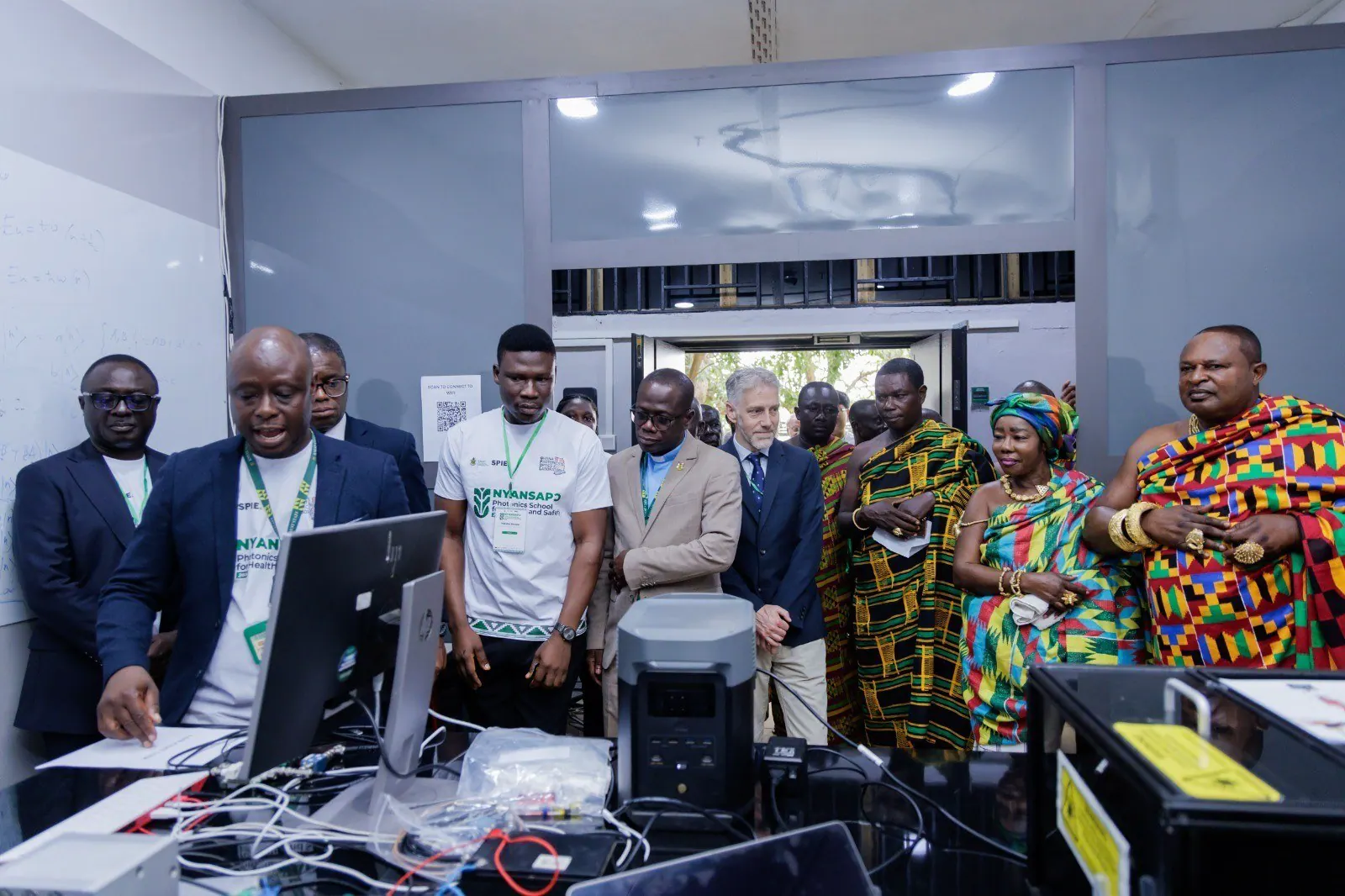
The Kwame Nkrumah University of Science and Technology (KNUST) has launched the Ghana Photonics and Optics Laboratory (GPOL), a facility that can detect malaria parasites in blood, test medicine composition, and check water and soil quality. Hosted within KNUST's Department of Physics, GPOL is only the second dedicated optics and photonics laboratory in Ghana and the first to be based at a university.
The facility grew out of research by Dr Akyana Britwum and Dr Michael Kweku Edem Donkor, who secured seed funding from SPIE, the International Society for Optics and Photonics, to get the project off the ground. GPOL has been equipped with teaching and measurement kits alongside research and community-built instruments, giving it the ability to analyse medicine composition, detect blood-borne parasites, and measure water and soil quality.
Photonics is the branch of science and technology that deals with generating and using light, including laser and fibre-optic technology, to measure, detect or transmit information. Speaking at the launch, Professor Philip Antwi-Agyei, Provost of the KNUST College of Science, said that a country unable to use light effectively ends up buying answers from elsewhere, and that the new laboratory was built to change that reliance for Ghana.
Professor David Asamoah, KNUST's Pro Vice-Chancellor, noted that decisions Ghana makes on safety and trade ultimately rest on measurement, and that for a long time both the instruments and the verdicts behind those measurements have come from outside the country. He urged local regulators to make full use of the new facility, given how often their work depends on optical measurement.
For ordinary Ghanaians, the new laboratory could eventually mean faster, locally-run checks on the safety of medicines sold in the country, quicker detection of malaria and other blood-borne parasites, and closer monitoring of water and soil quality without relying on tests carried out abroad. The launch also served as the centrepiece of the NYANSAPƆ Photonics School for Health and Safety.
The NYANSAPƆ Photonics School for Health and Safety brought together 38 students from six African countries for laboratory sessions, lectures and a keynote programme taught by 17 invited faculty from Spain, the United States, the United Kingdom, France, Côte d'Ivoire and Togo. Dr Peter de Groot, chair of the GPOL Advisory Board and 2025 President of SPIE, said the organisation was working to close Africa's capacity gap in photonics through an international training template, partnerships and initiatives.
University officials have described the lab as a long-term centre of excellence intended to train Ghana's next generation of scientists and innovators. The sources do not give a specific date for when GPOL will begin regular research or testing services, or when regulatory bodies might start formally using its facilities.
Key points
- The laboratory can detect malaria parasites in blood, test medicine composition, and check water and soil quality.
- The facility is the first university-based photonics lab in Ghana.
- The laboratory aims to train Ghana's next generation of scientists and innovators.