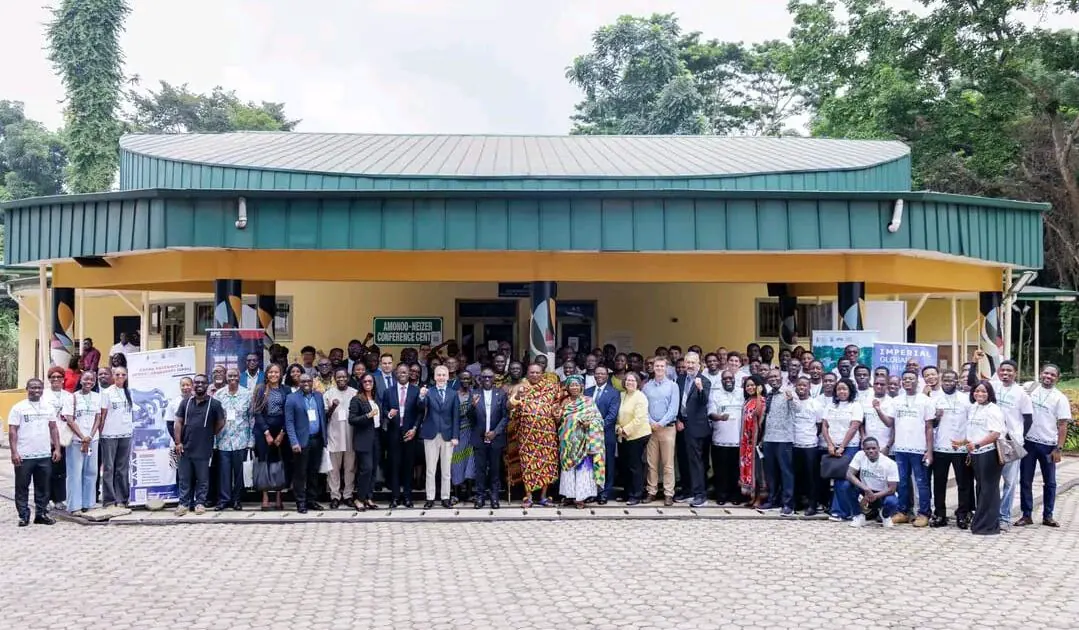
The Kwame Nkrumah University of Science and Technology (KNUST) has officially inaugurated the Nyansapo Photonics School, a six-day initiative aimed at providing hands-on optics training to students from Ghana and the wider African region. The programme, which runs from September 21 to 26, has convened 38 emerging scientists from six African countries and leading photonics researchers from Africa, Europe, and North America. This event marks a significant step in strengthening Ghana's capacity in light-based science.
The Nyansapo Photonics School is part of a broader effort to establish Ghana as a hub for photonics training in the region. The school's focus on health and safety is particularly relevant, given the critical role that photonics and optics play in modern innovation. According to Dr. Akyana Britwum, Principal Investigator and Scientific Lead, photonics underpins many modern technologies, yet Ghana has remained largely an end-user of foreign technologies. The school aims to change this narrative by empowering Ghanaians to pursue locally relevant science using advanced tools.
The inauguration of the Nyansapo Photonics School also marked the commissioning of the Ghana Photonics and Optics Laboratory (GPOL), a state-of-the-art teaching, research, and outreach laboratory hosted at the KNUST Department of Physics. GPOL is dedicated to advancing research, training, and outreach in optics and photonics in Ghana and across West Africa. The laboratory's focus spans fundamental optics and instrumentation science to applications in health, agriculture, industry, and the environment.
Dr. Akyana Britwum emphasized the need for Ghana to invest deliberately in research that addresses local challenges and drives homegrown solutions. He noted that photonics is not introduced early in Ghana's educational curriculum, with students typically hearing about it only in university. To address this gap, GPOL has rolled out over 30 outreach programmes across the country, engaging over 6,000 students. The initiative aims to demystify photonics and optics and inspire interest in light-based sciences among young learners.
The 2025 President of SPIE, Dr. Peter de Groot, underscored the importance of optics and photonics to Ghana's national development strategy. He described the establishment of GPOL as a critical opportunity for students and researchers to pursue world-class science locally. Dr. de Groot noted that the impact of light-based sciences cuts across key sectors of the economy, including healthcare, infrastructure, telecommunications, mining, and agriculture.
Dr. Peter de Groot also highlighted the benefits of GPOL in providing students with a strong practical foundation in mathematics and science that can be applied across diverse fields. He expressed optimism that GPOL will drive high-quality research and position Ghana as a regional hub for photonics training. The laboratory will also help reverse the trend of Ghanaian students having to travel abroad to access quality research facilities.
The Technical Lead and Co-Principal Investigator, Dr. Michael Kweku Edem Donkor, outlined the core mandate of GPOL, which includes the development of undergraduate and postgraduate programmes in optics and photonics, as well as cutting-edge research in low-cost instrumentation, materials characterization, and medical optics/biophotonics. The establishment of GPOL and the Nyansapo Photonics School marks a significant milestone in Ghana's efforts to enhance research and innovation in photonics and optics.
Key points
- The Nyansapo Photonics School and GPOL aim to empower Ghanaians to pursue locally relevant science using advanced tools.
- The initiative seeks to address the gap in Ghana's educational curriculum, where photonics is not introduced early.
- GPOL will provide students with a strong practical foundation in mathematics and science, positioning Ghana as a regional hub for photonics training.