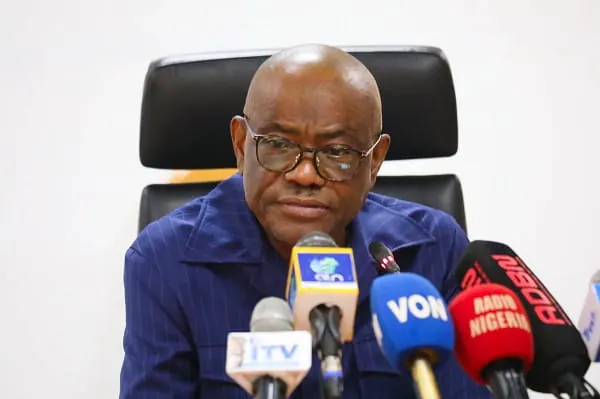
The Minister of the Federal Capital Territory (FCT), Nyesom Wike, has clarified the strategy adopted by the Peoples Democratic Party (PDP) G5 governors during the 2023 presidential election. According to Wike, the G5's plan was to prevent the party's presidential candidate, Atiku Abubakar, from securing enough votes to win the election. This clarification comes as part of the ongoing political activities ahead of the 2027 general elections. Wike's comments are seen as an effort to provide insight into the G5's actions during the 2023 elections.
Wike explained that the G5 developed a strategy based on its assessment of the political strength of the major contenders in the 2023 presidential election. The South-South region, traditionally a stronghold of the PDP, was a crucial consideration for the G5. By supporting the Labour Party presidential candidate, Peter Obi, in Rivers State, the G5 aimed to deny Atiku the votes from this region. This strategic move was intended to weaken Atiku's position in the election. Wike emphasized that the G5's goal was to ensure that Obi won in Rivers State.
The Minister dismissed claims that the outcome in Rivers State was achieved through election result manipulation. Instead, he argued that the G5's political strategy contributed to the result. Wike also rejected conclusions based on social media reports, emphasizing that election outcomes should be assessed from polling-unit results and official processes, rather than online narratives. According to Wike, social media does not win elections. He stressed that political actors should not conclude that a candidate has won based on limited polling unit results.
Wike further argued that even if Obi had won Rivers State, it would not have necessarily changed the overall outcome of the 2023 presidential election. He posed a rhetorical question, asking if Obi winning Rivers State would have been enough for him to win the election. The Minister maintained that the G5 had identified Atiku as its principal political opponent and developed its strategy accordingly. Wike stated that the G5's major problem and opponent was Atiku Abubakar.
The Minister dismissed suggestions that the G5's strategy amounted to controlling or determining the votes of Rivers State residents. Instead, he insisted that the group was operating within a broader political strategy. Wike emphasized that political parties and candidates should understand that elections involve strategies and calculations. Political actors assess their major opponents and determine how best to strengthen their own position. According to Wike, the G5's actions were part of this broader strategy.
Wike's comments have sparked reactions from various stakeholders, with some interpreting his statements as an effort to justify the G5's actions during the 2023 elections. Others have seen his comments as a reflection of the ongoing political tensions within the PDP. As the 2027 general elections approach, political actors are positioning themselves for the contests. Wike's statements have provided insight into the G5's strategy during the 2023 elections.
The G5's strategy and Wike's comments have raised questions about the role of political strategies in shaping election outcomes. The Minister's statements have also highlighted the importance of assessing election outcomes based on official results and processes. As the political landscape continues to evolve, stakeholders will be watching closely to see how the G5 and other political actors position themselves for the 2027 elections.
Key points
- The G5's strategy was to deny Atiku Abubakar votes in the 2023 presidential election by supporting Peter Obi in Rivers State.