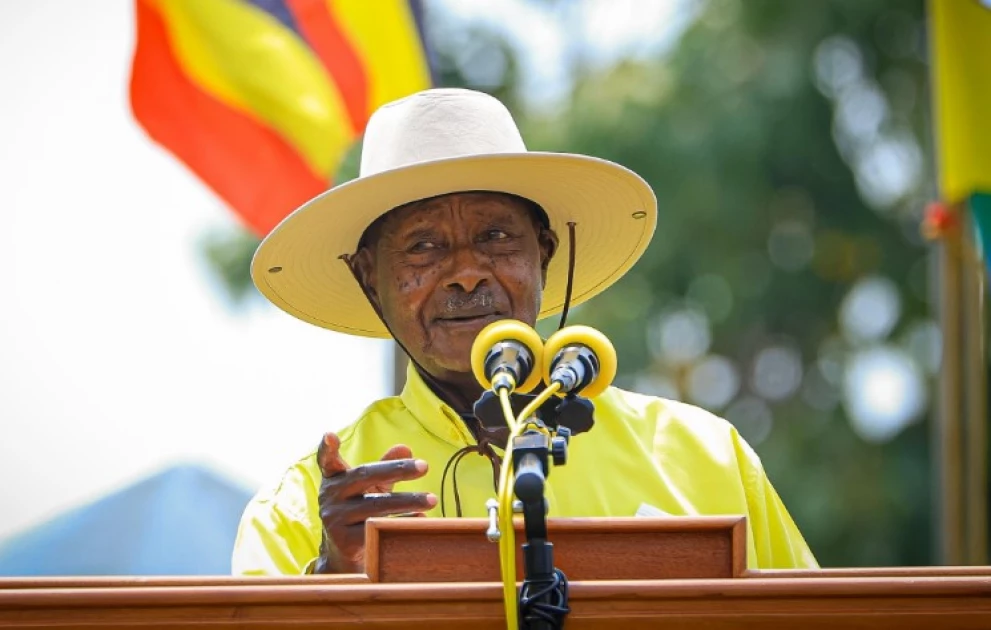
Ugandan President Yoweri Museveni has identified a Kenyan legislator, Senator Cyrus Jirongo, as the whistleblower who exposed irregularities in East Africa's Government-to-Government (G-to-G) oil importation deal. According to Museveni, Jirongo informed him about the backdoor oil dealings in 2019. Museveni tasked the then Minister Irene Muloni to address the issue. The revelations were made during a groundbreaking ceremony for a 320-million-litre petroleum storage terminal in Mpigi District, Uganda.
Museveni's exposé revealed that Uganda had previously procured petroleum products through intermediaries in Kenya, rather than directly from the government as outlined in the G-to-G framework. The Ugandan president expressed disappointment that his government officials failed to identify the costly procurement arrangement. He announced that Uganda would end the G-to-G arrangement with Kenya and begin sourcing bulk petroleum products directly.
The Kenyan Ministry of Energy responded to Museveni's allegations, dismissing claims of irregularities in the importation and supply of refined petroleum products under the G-to-G arrangement. Energy CS Opiyo Wandayi stated that Kenya brokered an importation deal with private companies in 2023 to alleviate liquidity challenges caused by dollar scarcity. The deal involved Aramco Trading Fujairah FZE, Abu Dhabi National Oil Company Global Trading Ltd, and Emirates National Oil Company.
Wandayi explained that International Oil Companies (IOCs) appointed licensed counterparties in Kenya for local supply logistics, including Gulf Energy Limited, Galana Energies Limited, and Oryx Energies Kenya Limited. As the arrangement progressed, more counterparties were nominated, such as One Petroleum Limited, Asharami Synergy Limited, and BE Energy Limited. The Kenyan minister emphasized that the transaction was de-risked, leading to higher confidence by the IOCs.
Former Deputy President Rigathi Gachagua responded to Museveni's revelations, stating that they reinforced concerns he had previously raised about the G-to-G deal. Gachagua accused President William Ruto of orchestrating the oil supply irregularities through proxies in the Middle East. He alleged that Ruto identified three companies and made a deal with them, then looked for a proxy, a company called Gulf Oil.
Gachagua's allegations imply that President Ruto was involved in the irregularities, but there is no concrete evidence to support these claims. The Kenyan government has not officially responded to Gachagua's accusations. The issue has sparked a heated debate about the G-to-G deal and the involvement of middlemen in the oil importation process.
The controversy surrounding the G-to-G oil deal has raised questions about the transparency and accountability of the oil importation process in East Africa. The Ugandan government's decision to end the G-to-G arrangement with Kenya and source bulk petroleum products directly may have significant implications for the region's oil market.
Key points
- Kenyan Senator Cyrus Jirongo exposed middlemen in G-to-G oil deal
- Uganda ends G-to-G arrangement with Kenya
- Irregularities in oil importation process spark controversy in East Africa