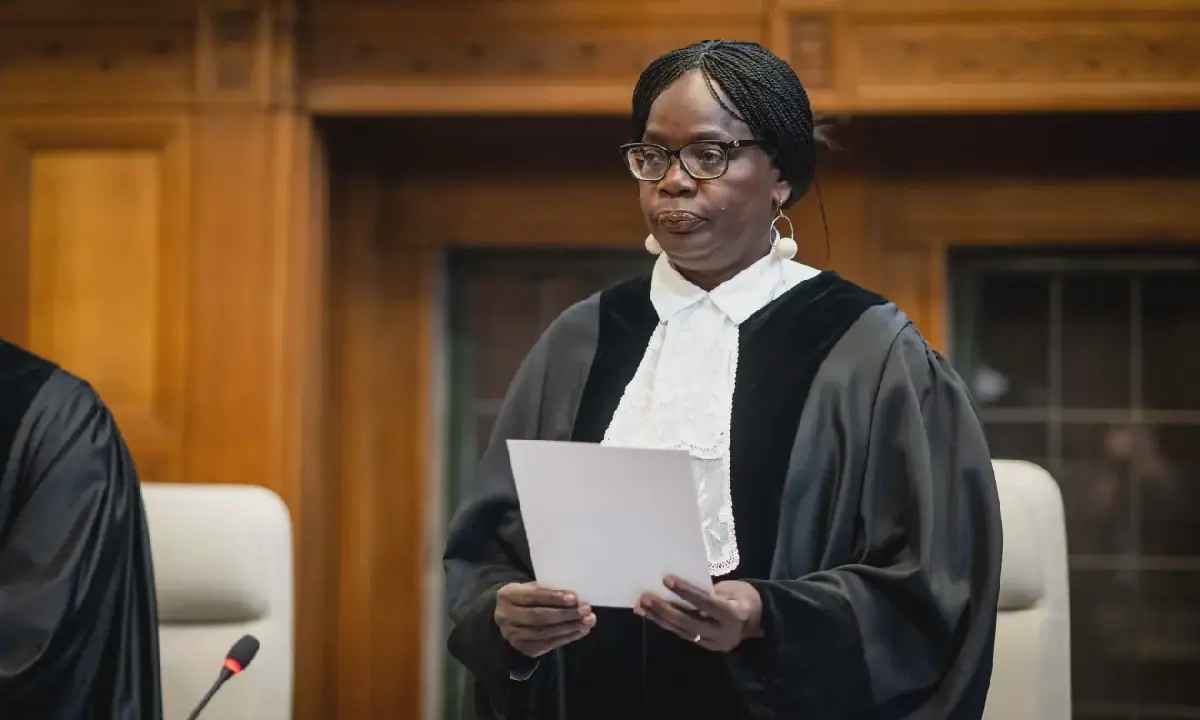
Kenyan professor Phoebe Okowa has been elected as a judge of the International Court of Justice (ICJ) for a nine-year term. She won the election with 183 votes out of the total votes cast by UN member states. Okowa, 61, defeated her opponent Luz del Carmen Ibáñez Carranza of Peru, who received only two votes. Six countries did not vote in the final round.
Okowa's election was a significant achievement, as she had to secure a majority in both the UN General Assembly and the Security Council. In the Security Council, she received strong support, which was not the case in the previous round when she got only six votes out of 15. Okowa has been serving in the ICJ since last year, filling a vacancy left by Somali judge Abdulqawi Ahmed Yusuf, who resigned before his term ended in January 2027.
The election for the ICJ judge position became an African affair after the African Union failed to persuade Okowa and Sierra Leonean lawyer Charles Chernor Jalloh to withdraw. In the second round, Okowa received 89 votes in the General Assembly but was not elected due to insufficient support in the Security Council. Jalloh received 30 votes. Later, Jalloh and two other candidates withdrew, leaving Okowa and the Peruvian candidate to compete in the final round.
The ICJ election requires a candidate to receive a majority in both the General Assembly and the Security Council. Okowa's expertise in international law and her experience as a member of the UN's International Law Commission were significant factors in her election. As a judge, she will be independent and make decisions based on the law and her judicial oath, even in cases involving Kenya.
Okowa's election was welcomed by the Kenyan government, with Foreign Affairs Ministry Principal Secretary Korir Sing'oei stating that her expertise would help the ICJ develop a rules-based global order. The ICJ has 15 judges and its primary role is to hear disputes between nations. It can also provide advisory opinions at the request of the UN General Assembly.
Okowa's background in international law is extensive. She has taught at various universities and has been a member of the UN's International Law Commission. Her experience and expertise will be valuable assets to the ICJ. As a judge, she will be required to make impartial decisions, upholding the law and the integrity of the ICJ.
The ICJ is distinct from the International Criminal Court (ICC), which handles cases against individuals accused of international crimes. The ICJ focuses on disputes between states and provides a platform for peaceful resolution of conflicts. Okowa's election is a significant milestone for Kenya and Africa, as it highlights the country's and continent's growing influence in international affairs.
Key points
- Phoebe Okowa received 183 votes to become the International Court of Justice judge.
- Okowa's election was a significant achievement for Kenya and Africa.
- The ICJ has 15 judges and its primary role is to hear disputes between nations.