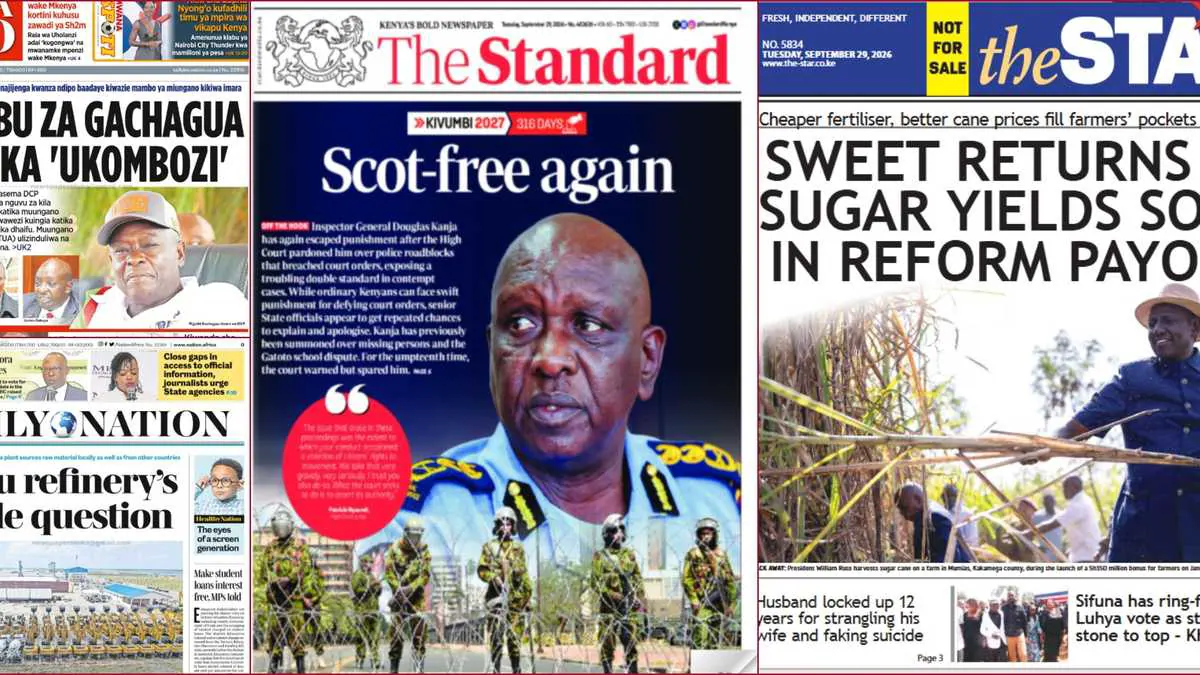
The Democracy for the Citizens Party (DCP), led by former deputy president Rigathi Gachagua, has declined to join the Ukombozi Alliance launched by Wiper leader Kalonzo Musyoka. According to DCP Advisory Council chairperson Maina Kamanda, the party must first strengthen its internal foundations before committing to any coalition arrangement ahead of the 2027 general election. This decision comes as the opposition prepares for the upcoming elections.
Kalonzo unveiled the Ukombozi Alliance on September 21, 2026, as a successor to the Azimio la Umoja-One Kenya coalition that was assembled by former President Uhuru Kenyatta before the 2022 elections. Musyoka indicated the new alliance would be open to additional parties, including DCP. However, Kamanda explained that DCP believes it has the capacity to attract more than eight million votes on its own and is therefore unwilling to enter any coalition without first assessing each prospective partner's contribution.
DCP deputy leader Cleophas Malala stated that the party could work with Nairobi Senator Edwin Sifuna separately before considering any broader arrangement. Malala emphasized that the DCP-Sifuna partnership is one force and Ukombozi is another, and that the two forces can only negotiate on how to tackle the 2027 election while remaining as independent entities. This suggests that DCP is open to collaborations, but only on its own terms.
Gachagua himself signalled the same position while speaking from the United States on September 19. He stated that the party is focused on consolidating itself, not on negotiations, and that no party can negotiate from a position of weakness. Gachagua added that DCP will consider alliances after it has fully strengthened its support base. This approach indicates that DCP is prioritizing its internal growth over immediate coalition-building.
Other DCP leaders, including secretary general John Methu, echoed Gachagua's sentiments. Methu rejected suggestions that the party's stance reflected self-interest or a reluctance to cooperate with the broader opposition. Instead, he emphasized that DCP is not ready to be someone's employee in an opposition coalition, and that if the party believes it has its own numbers, it will take them where it wants. This stance suggests that DCP is seeking a more equal partnership.
The standoff points to underlying tensions within Kenya's opposition over the distribution of political influence, regional representation, and the terms on which any pre-election coalition for 2027 might be constructed. Meanwhile, President William Ruto has called on Kenyans to shelve political divisions and rally behind development initiatives. During a tour of the Coast region, Ruto launched several projects, including the Sh2 trillion East African Refinery in Lamu.
Ruto's development tour also included the issuance of title deeds to landowners in the region. The president acknowledged that disputes over land ownership had driven decades of poverty, evictions, and conflict in the Coast region, and pledged to make good on a 2022 campaign promise to resolve the issue. The government aims to issue approximately 500,000 title deeds across the region by December, with 192,166 title deeds set to be distributed during the current development tour.
Key points
- DCP's decision to decline joining the Ukombozi Alliance reflects its focus on strengthening its internal foundations ahead of the 2027 elections.