Martha Karua, the leader of Kenya's People's Liberation Party, has taken the Ugandan government to court over a decision to bar her from entering the country. Karua filed a judicial review application at Uganda's High Court in Kampala, seeking to overturn the decision by immigration authorities that declared her an unwanted person. The decision was made on June 22, when Karua arrived in Uganda to represent Dr. Kizza Besigye and Hajj Obeid Lutale in ongoing treason proceedings.
Karua and the Uganda Law Society, which filed the case jointly, argue that the decision was unlawful, arbitrary, and made without affording Karua any opportunity to respond or be heard. Upon arrival, immigration officers confiscated her mobile phones before serving her with the notice barring her entry. Anthony Asiimwe, Vice President of the Uganda Law Society, stated that he had personally travelled to Entebbe to receive Karua after her arrival from Kenya, only to find that immigration officials had already blocked her entry.
The case is closely connected to earlier legal proceedings involving Dr. Besigye, a prominent Ugandan opposition figure, and Lutale, who were arrested in Nairobi in November 2024 and charged with treason and concealing treasonous information. Karua holds Senior Counsel status and carried a valid Special Certificate of Admission issued under Section 18 of the Advocates Act, which authorised her to lead the defence team in the case.
Through the High Court's Judicial Review Division, Karua and the Uganda Law Society are asking the court to declare the immigration decision illegal, unreasonable, and procedurally improper. They are seeking an order quashing the declaration and directing immigration authorities to reconsider the matter, as well as a permanent injunction preventing officials from obstructing Karua's entry into Uganda for professional purposes.
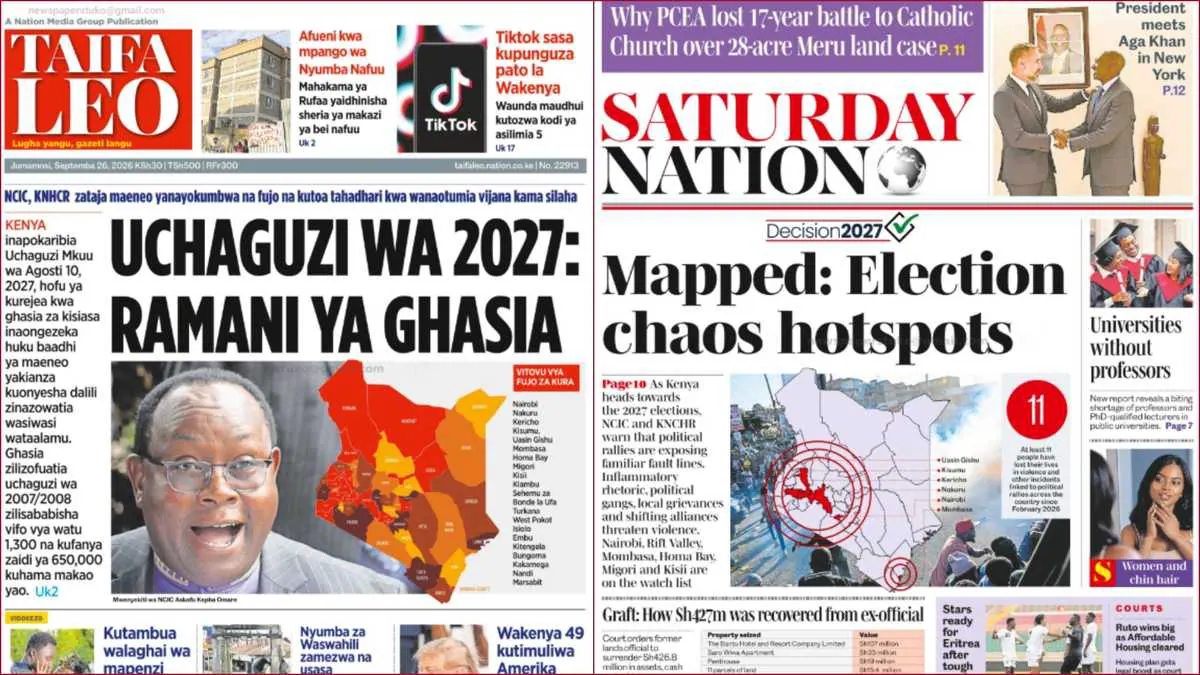
In a separate news story, concerns are rising over potential political violence in Kenya ahead of the general election scheduled for August 10, 2027. Human rights bodies, national commissions, and security analysts have identified at least 19 counties as high-risk zones. Recent weeks have seen a series of violent incidents at political gatherings across the country, including attacks on supporters of the Linda Mwananchi coalition in Homa Bay and clashes at a political meeting in Nembure, Embu.
The Kenya National Commission on Human Rights has confirmed that at least 11 people have been killed since February this year in incidents connected to political gatherings. The commission has flagged ongoing tensions along the Turkana-West Pokot border, as well as in Isiolo, Embu, and several other counties, as early warning signs requiring urgent intervention.
Security analysts have identified Nairobi, parts of the Rift Valley, Mombasa, Homa Bay, Migori, Kisii, and Kiambu as areas of persistent concern. A broader list of high-risk areas includes Nakuru, Kericho, Kisumu, Uasin Gishu, Turkana, West Pokot, Isiolo, Embu, Kitengela, Bungoma, Kakamega, Nandi, and Marsabit, which have been flagged on the basis of past violence, land disputes, ethnic rivalries, and intense political competition.
Key points
- Martha Karua has filed a lawsuit against the Ugandan government over a decision to bar her from entering the country.
- The case is closely connected to earlier legal proceedings involving Dr. Kizza Besigye and Hajj Obeid Lutale.
- Concerns are rising over potential political violence in Kenya ahead of the general election scheduled for August 10, 2027.