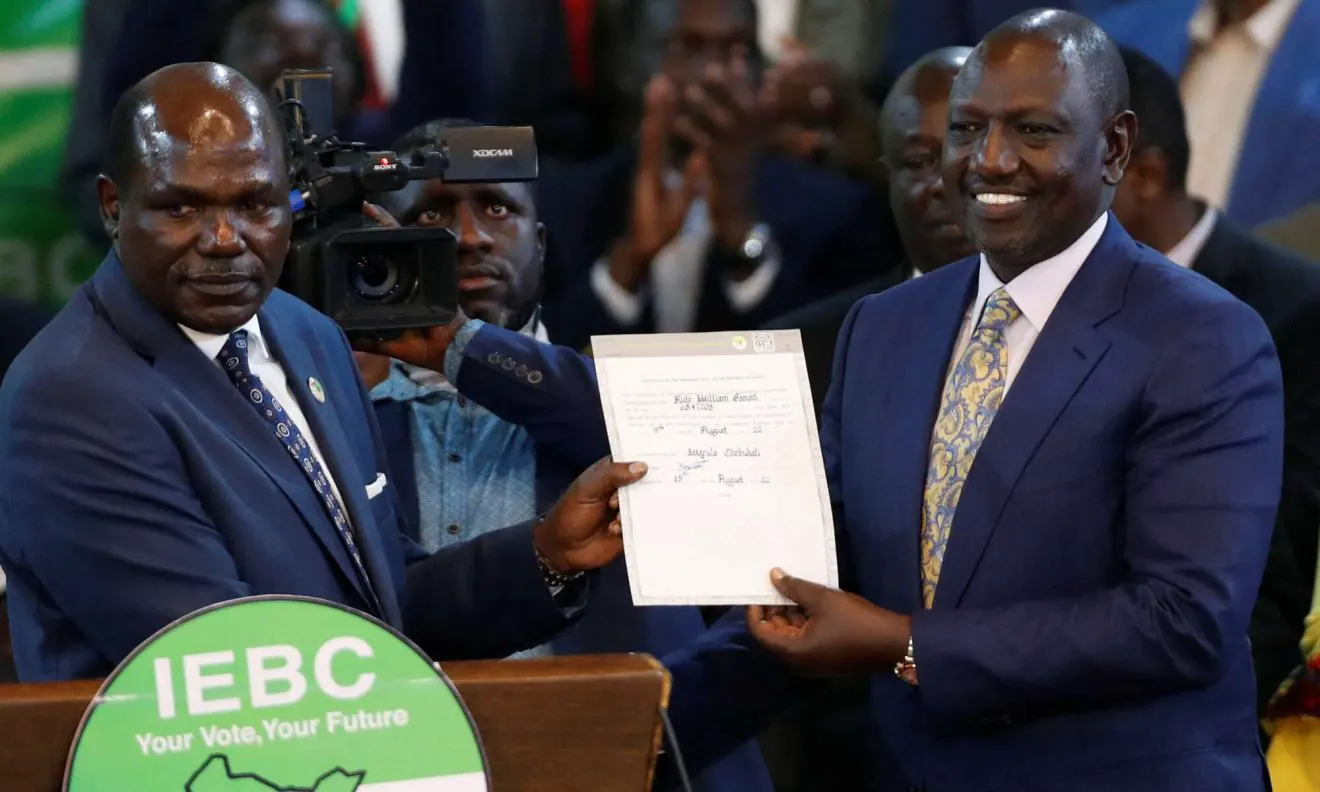
The High Court of Kenya has made a ruling that upholds the Independent Electoral and Boundaries Commission's (IEBC) role in verifying presidential election results at the national level. The court dismissed a petition filed by opposition leaders Kalonzo Musyoka, Rigathi Gachagua, and Fred Matiang'i, as well as activist Okiya Omtatah Okoiti, who challenged the IEBC's authority in this matter. The petitioners argued that the results announced by election officials at constituency levels were final and should not be recounted or re-verified at the national level.
The court's decision, delivered by Judge Gregory Mutai, stated that the Constitution grants the IEBC the power to compile and verify results at the national level to determine if a candidate has met the required threshold to be elected President. The judge emphasized that the IEBC's role is not to overturn the decisions made at the constituency level but to aggregate and verify the results. This ruling has significant implications for the electoral process in Kenya, particularly with regards to the 2027 general elections.
The court's ruling also clarified the scope of the IEBC's authority, stating that while the commission has the power to compile and verify results, it cannot alter, cancel, or revise the results except on the orders of a court. Furthermore, the court ruled that the results verified at the constituency level, including those recorded in Forms 34A and 34B, will serve as the basis for the national tally. The court rejected the use of electronic data or databases as a substitute for these official records.
The petitioners had also requested that the court order the IEBC to establish a specific timeline for publishing the voter register, declaring polling stations, and setting up a results transmission system. However, the court declined to make such orders, citing that these matters fall within the IEBC's and Parliament's jurisdictions. The court's decision has been seen as a significant development in Kenya's electoral process, particularly in the run-up to the 2027 general elections.
The ruling has also addressed concerns about the potential for bias in the electoral process. The court noted that the results of the presidential election are treated differently because the President must meet a specific national threshold. This distinction, the court argued, justifies the IEBC's role in verifying results at the national level. The court's decision is expected to inform the review of electoral laws before the 2027 elections.
The case had centered on the IEBC's National Tallying Center, which is responsible for aggregating and verifying presidential election results. The petitioners had argued that the center's role was unlawful, while the IEBC maintained that it was necessary to ensure the accuracy and transparency of the electoral process. The court's ruling has provided clarity on the IEBC's authority in this regard, ensuring that the commission can continue to play a critical role in Kenya's electoral process.
The court's decision has been welcomed by stakeholders who see it as a crucial step towards consolidating Kenya's democratic institutions. The ruling is expected to enhance the credibility and transparency of the electoral process, particularly in the lead-up to the 2027 general elections. As Kenya continues to refine its electoral laws and processes, the court's decision will remain an important reference point for ensuring the integrity of the country's democratic processes.
Key points
- The Kenyan High Court has upheld the IEBC's authority to compile and verify presidential election results at the national level.