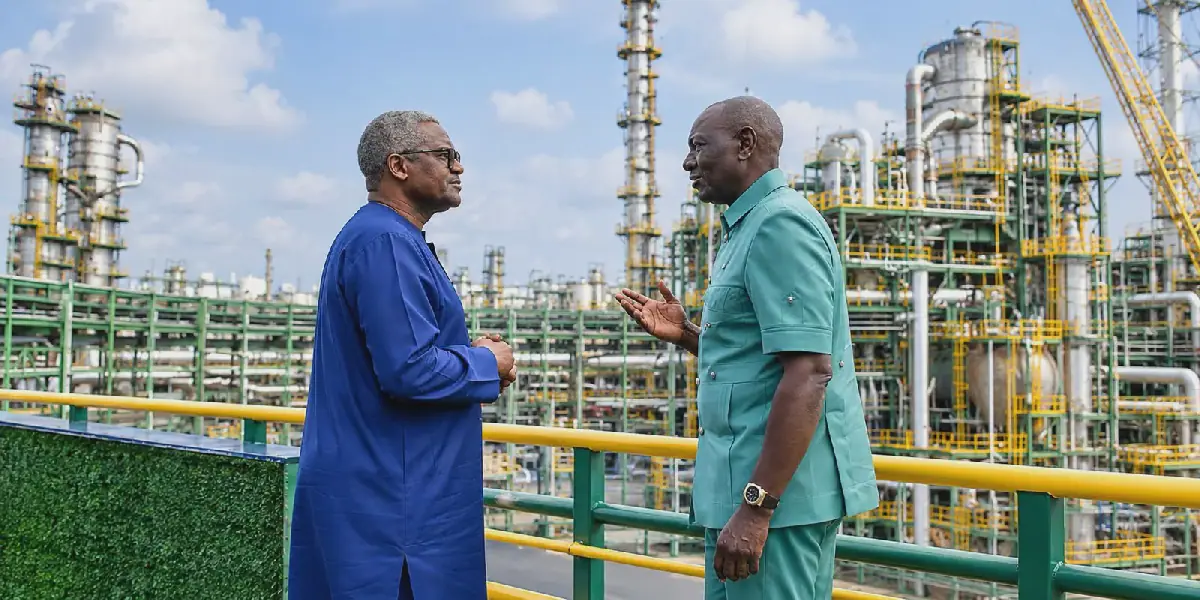
The Kenyan government has announced plans to grant tax exemptions to Aliko Dangote's $16 billion oil refinery project in Lamu. Treasury Secretary John Mbadi stated that the exemptions will cover value-added tax, excise duty, and the railway development levy on capital goods, including machinery and equipment. This move is expected to support the development of the refinery, which will process 700,000 barrels of crude oil daily.
The tax exemptions are contingent on the project's investment exceeding the minimum threshold of 5 billion Kenyan shillings, approximately $38 million. Mbadi noted that Dangote must submit a formal application to obtain the exemptions and may also recover taxes already paid on imported equipment. The refinery's groundbreaking ceremony took place on September 30, 2026, with completion expected in about 40 months and commissioning targeted for 2030.
The Lamu refinery project has already secured significant contracts, including a deal worth over $450 million with India's Engineers India Limited. Additionally, US-based Honeywell Technologies will provide engineering services, technology licensing, and equipment for the facility. These partnerships are crucial to the project's success and will help Kenya achieve its energy goals.
The planned exemptions are part of Kenya's broader strategy to attract investments. The country's tax expenditure stood at 262.6 billion Kenyan shillings ($2.02 billion) in 2025, accounting for about 1.5% of GDP. By granting tax exemptions, the government aims to encourage large-scale investments like the Dangote refinery, which is expected to have a significant impact on the economy.
The Dangote refinery project is a major undertaking that requires substantial investment and infrastructure development. The project's success will depend on various factors, including the timely completion of construction, the availability of crude oil, and the refinery's ability to meet Kenya's energy demands. The government's support through tax exemptions is expected to play a crucial role in ensuring the project's viability.
In a separate development, the Supreme Court has scheduled a hearing for an appeal by Adelegbe, who is seeking to set aside the Court of Appeal's judgment recognizing Arobo as the APC candidate for Owo/Ose Federal Constituency. The appeal contains 18 grounds and was filed by a legal team led by Joseph Daudu, SAN. The court's decision will have implications for the APC and INEC.
The tax exemptions for the Dangote refinery are a significant development in Kenya's efforts to attract large-scale investments. The project's success will depend on various factors, including the effective implementation of the tax exemptions and the company's ability to manage the project's complexities. Key points include:
Key points
- The Kenyan government will grant tax exemptions on capital goods for Dangote's $16 billion Lamu refinery.
- The exemptions will cover VAT, excise duty, and the railway development levy on machinery and equipment.
- The project's completion is expected by 2030, with a capacity to process 700,000 barrels of crude oil daily.
Reporting sources
- Kenya to grant Dangote tax exemptions on equipment for $16bn Lamu refinery · West Africa News Agency