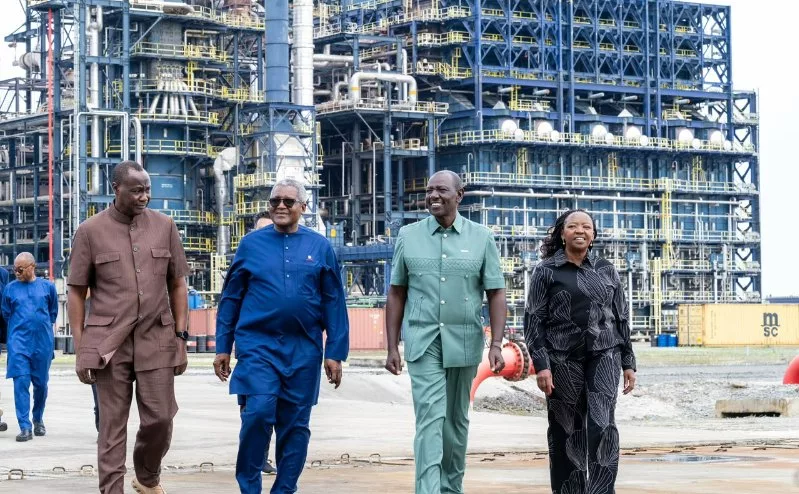
Kenya and Nigeria's Dangote Group have broken ground on a $16 billion refinery in Lamu, Kenya, designed to process 700,000 barrels of crude oil a day. The project, led by Kenyan President Ruto and Aliko Dangote, founder and CEO of the Dangote Group, aims to reduce the region's dependence on imported refined fuels. The refinery's construction has sparked debate over its viability, with skeptics questioning the availability of feedstock and logistics.
Critics argue that the refinery's daily crude oil requirement of 700,000 barrels cannot be met by regional fields in Turkana and Uganda, which are constrained by pending pipeline connections and production limits. Additionally, Lamu lacks operational bulk oil storage terminals, localized pipeline networks, and deep-water offloading infrastructure required to handle mega-tankers. Environmental concerns have also been raised, including the potential for coastal pollution, destruction of mangrove ecosystems, and unresolved land compensation claims.
The project's critics also raise broader economic and political concerns, including security risks near unstable border zones, climate change implications, and potential contingent liabilities for regional treasuries. However, proponents argue that large refining capacity is a structural requirement for East Africa, which currently imports refined fuels. The region, comprising Kenya, Uganda, South Sudan, Rwanda, and the eastern Democratic Republic of Congo, forms a market large enough to justify domestic processing.
Economist Albert Hirschman's concept of the "Hiding Hand" suggests that ambitious projects are often undertaken without full knowledge of the difficulties ahead. Once committed, the necessary ingenuity, partnerships, and institutional capacity are discovered to complete them. Yataro Nishiyama, the founding president of Kawasaki Steel Corporation, demonstrated a similar approach when he built Japan's first modern coastal integrated steel plant, despite skepticism over feedstock availability.
A coastal refinery can import crude oil, and its viability depends on the delivered price of that crude, the cost of processing it, and the price at which it can sell its products. Dangote's refinery in Nigeria, for example, imports crude from various countries, including the United States, Libya, and Guyana. Similarly, Kenya's refinery can source crude from international markets, and talks are underway on a pipeline from Turkana's fields to Lamu that would feed the refinery.
The absence of a pipeline from Turkana to Lamu is cited as a reason for skepticism, but proponents argue that the absence of a refinery is a large part of why there is no pipeline. The project creates a business case for upstream investment that was not going to happen on its own. The feedstock critics are treating the absence of a pipeline as a reason not to build the refinery, rather than as a challenge to be addressed.
The Lamu refinery project has the potential to drive industrial growth and reduce the region's dependence on imported refined fuels. While challenges and criticisms exist, the project's proponents believe that it can be completed with the necessary ingenuity, partnerships, and institutional capacity. The project's success could also have far-reaching implications for the region's economic development and energy security.
Key points
- The Lamu refinery project aims to process 700,000 barrels of crude oil a day and reduce the region's dependence on imported refined fuels.
- Critics question the availability of feedstock and logistics, while proponents argue that the project can be completed with the necessary ingenuity and partnerships.
- The project's success could drive industrial growth and have far-reaching implications for the region's economic development and energy security.