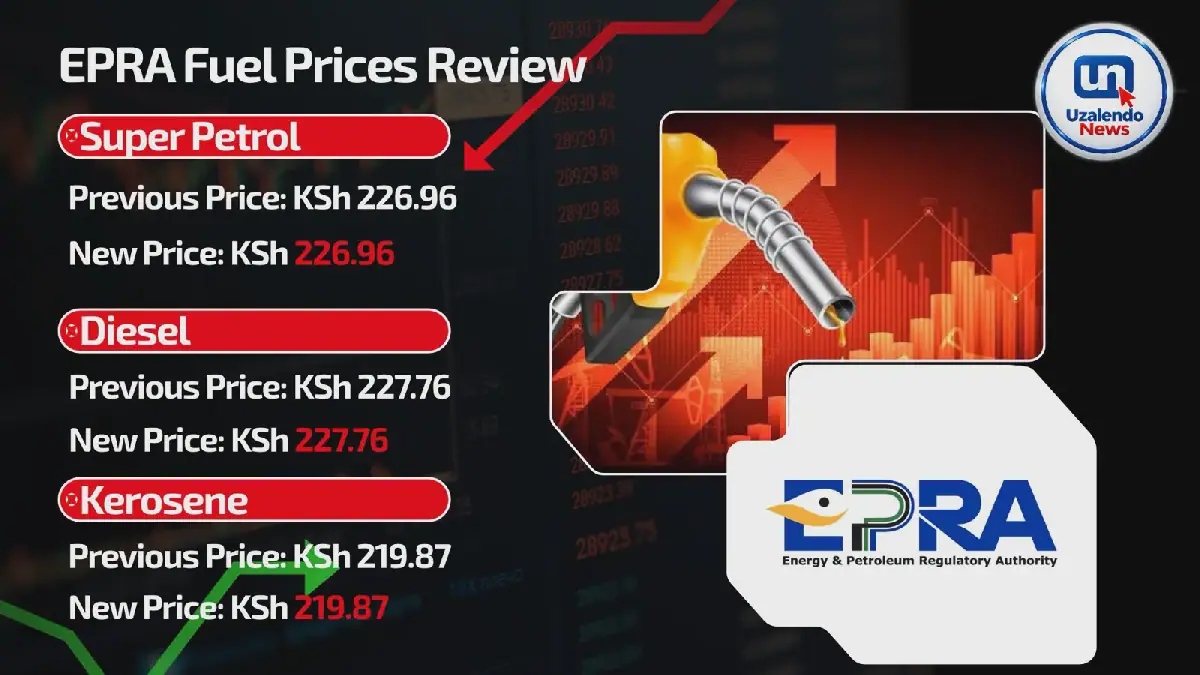
The Energy and Petroleum Regulatory Authority (EPRA) in Kenya has announced that maximum retail fuel prices will remain unchanged across the country for the November 15 to December 14, 2026 pricing cycle. This decision comes despite a recent 15% decline in international crude oil prices, which had led many to expect a price cut. EPRA's monthly tariff review set Nairobi's rates at Sh226.96 per litre for Super Petrol, Sh227.76 for Diesel, and Sh219.87 for Kerosene.
The unchanged fuel prices are a continuation of the elevated levels introduced on October 15, when the regulator raised Super Petrol by Sh12.93, Diesel by Sh9.90, and Kerosene by Sh28.49 per litre. Other major towns in Kenya, including Mombasa, Nakuru, Kisumu, and Eldoret, will see identical freezes. For instance, Mombasa's rates are set at Sh223.81 for Super Petrol, Sh224.61 for Diesel, and Sh216.71 for Kerosene. Similarly, Nakuru's rates are Sh225.73, Sh226.93, and Sh219.06 respectively.
The decision to keep fuel prices unchanged comes as a result of various factors, including Kenya's importation of refined petroleum products rather than crude oil. Shifts in crude prices do not instantly affect local retail rates due to shipping lead times, refined-product quotations, and existing tax structures. This means that the recent decline in global crude oil benchmarks has not immediately translated to lower pump prices in Kenya.
The Central Bank of Kenya's exchange rate, quoted at Sh129.96 per US dollar, could potentially ease import costs. However, this has not led to a price reduction announcement from EPRA. The unchanged rates provide short-term stability for businesses and households, particularly as the country heads into the December festive travel season. Nevertheless, overall logistics and production costs remain elevated.
The fuel prices have been a significant concern for many Kenyans, with the November-December cycle seeing no change despite expectations of a price cut. The EPRA's decision is likely to have various impacts on different sectors of the economy, from transportation to manufacturing. With the festive season approaching, many households and transport operators will be closely monitoring the fuel prices and their effects on their budgets.
The EPRA's monthly review of fuel prices is a critical exercise that affects the cost of living and doing business in Kenya. The authority's decision to maintain the current prices is a balancing act between the global crude oil price trends and the local economic conditions. As the country navigates the complexities of the global oil market, the EPRA's role in regulating fuel prices remains crucial.
As Kenya looks to the future, the fuel price trends will continue to be a key area of focus for economic stakeholders. The EPRA's commitment to regular reviews of fuel prices aims to provide stability and predictability in the market. With the current prices holding steady, Kenyans can expect a stable fuel market in the short term, but the long-term trends will depend on various factors, including global crude oil prices and local economic conditions.
Key points
- The Energy and Petroleum Regulatory Authority (EPRA) has left retail fuel rates steady for the November 15-December 14 period despite a recent 15% fall in international crude oil prices.