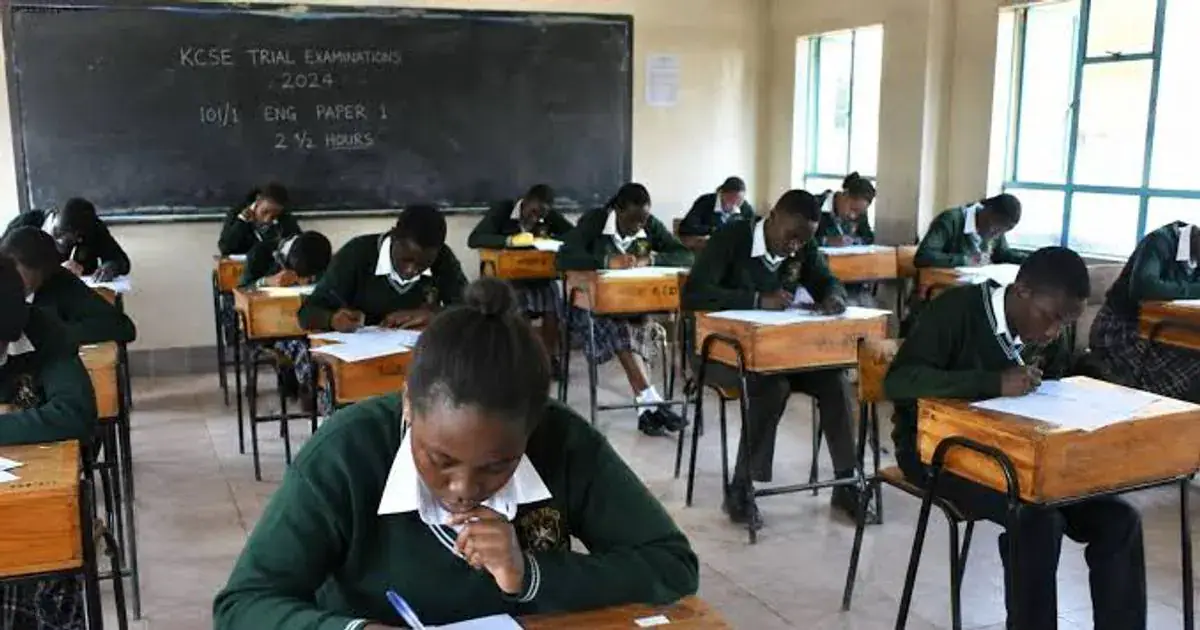
The 2026 Kenya Certificate of Secondary Education (KCSE) written examinations commenced on October 19, 2026, with main theory papers currently underway. This year's exam is the second-last sitting under Kenya's outgoing 8-4-4 curriculum. The Kenya National Examinations Council (KNEC) confirmed that the final KCSE examination will be administered in 2027, after which the regular school-going cohort will complete secondary education under the Competency-Based Education (CBE) system.
The transition to CBE follows the abolition of KCPE, whose final examination was held in 2023. The first cohort of learners under CBE entered Grade 10 in January 2026, beginning the three-year senior school stage. They are expected to complete Grade 12 in 2028 before progressing to universities, colleges, and technical institutions from 2029. A historic milestone of over 1,048,355 candidates are registered across 10,693 examination centers for the KCSE exam.
The new education structure, CBE, replaces the traditional 8-4-4 arrangement with a 2-6-3-3-3 structure. Learners spend two years in pre-primary education, six years in primary school, three years in junior school, and another three years in senior school. The curriculum places greater emphasis on practical abilities, problem-solving, creativity, communication, collaboration, and the application of knowledge rather than relying primarily on end-of-cycle examinations.
One of the biggest changes takes place when learners move from Grade 9 to Grade 10. Instead of following a largely uniform secondary-school curriculum, learners select from three senior-school pathways based on their interests, strengths, assessment performance, and intended careers. The pathways include Science, Technology, Engineering, and Mathematics (STEM), Social Sciences, and Arts and Sports Science.
The Ministry of Education's Grade 10 selection and placement platform allows learners to select their preferred pathways, subject combinations, and senior schools. The selection process also considers school capacity and the learner's assessment profile. Learners are assessed and placed through a junior-school placement framework, which includes the KJSEA national assessment, school-based assessments, and KPSEA results.
Under the CBE system, assessment continues through projects, practical assignments, and written tests. The new qualification at the end of Grade 12 will be the Kenya Certificate of Basic Education (KCBE). The first cohort is expected to undertake the examination in 2028 after completing the three-year senior-school cycle. Unlike KCSE, KCBE will operate within the competency-based assessment framework.
The 2027 KCSE examination will close the chapter on the 8-4-4 system, and the first KCBE cohort will provide the first full test of Kenya's new senior-school assessment model. KNEC has planned a pilot of the senior-school summative assessment in 2027. The transition to CBE aims to equip learners with practical skills and competencies required in the 21st century.
Key points
- Over 1,048,355 candidates registered for the KCSE exam across 10,693 examination centers.
- The new Competency-Based Education system replaces the traditional 8-4-4 arrangement with a 2-6-3-3-3 structure.
- The first KCBE cohort is expected to undertake the examination in 2028.