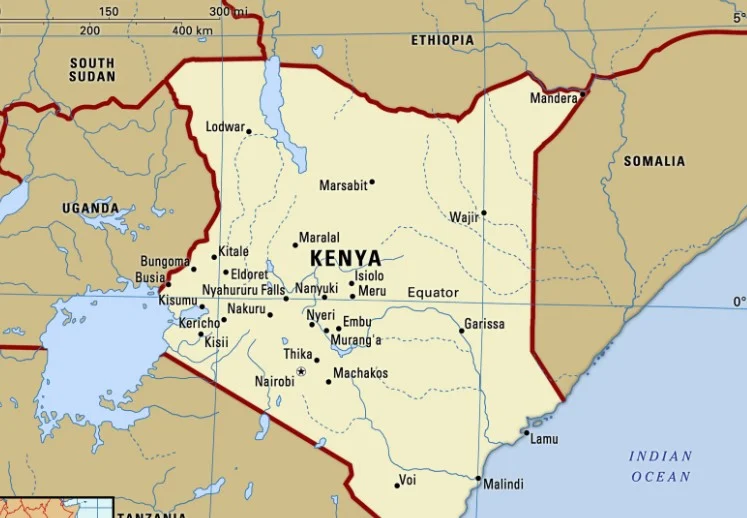
Kenya has launched the LuLu Coastal Cable System, a groundbreaking digital infrastructure project that aims to transform the country's coastal region. Developed by INDOI Ltd, Blue Trade Investments Limited, ARISE Integrated Industrial Platforms, AfriTrade Consulting Group, and Kingdom Bank Limited, the system will connect five strategic landing points along Kenya's 500-kilometer Indian Ocean coastline, from Mombasa to Lamu. The project was announced at ITW Africa 2026.
The LuLu Coastal Cable System is designed to provide greater resilience, redundancy, and network availability for governments, international operators, data-center companies, and other mission-critical users. The system combines a submarine cable laid along the ocean floor with a parallel, protected terrestrial route, and features a dual-path architecture. It will deploy dense wavelength division multiplexing technology in the 1550-nanometer window, with 144 fiber pairs and a design capacity of up to 60 terabits per second per fiber pair.
The LuLu Coastal Cable System is expected to be ready for service in the second quarter of 2028, subject to the execution of contracts, and is designed to operate for 25 years with centralized network management. According to Arunachalam Kandasamy, founder and Chief Executive Officer of INDOI Ltd, the project will address a longstanding infrastructure gap along Kenya's coast. Kandasamy emphasized that East Africa is a market of the present, and Kenya's coastal corridor is one of the most dynamic and strategically significant stretches of coastline globally.
The LuLu Coastal Cable System will provide a permanent digital backbone for Kenya's coastal corridor, supporting the development of hyperscale data centers, cloud-service regional nodes, business-process outsourcing, and global business-services campuses. The cable's landing at Vipingo Special Economic Zone (VSEZ) is expected to expand the zone's investment potential beyond conventional manufacturing and logistics. Blue Trade Investments Limited, INDOI's Kenya-registered infrastructure partner, will serve as the designated cable landing party, regulatory interface, and operational delivery partner for the project in Kenya.
The Vipingo SEZ is being developed as a major industrial and digital platform with the potential to mobilize up to $3 billion in investment. George Olaka, country head of ARISE IIP Kenya, claimed that the cable would strengthen Vipingo's ambition to become an integrated industrial and digital platform. Olaka emphasized that Vipingo SEZ was designed to be a platform where industry, logistics, value addition, and digital infrastructure can reinforce each other.
The LuLu Coastal Cable System project reflects the growing role of digital infrastructure in driving investment and economic activity. Anthony Mburu, Managing Director and Chief Executive Officer of Kingdom Bank Limited, noted that the project highlights the increasing importance of digital infrastructure in driving investment, connectivity, and economic activity along Kenya's coast. Dr. Caroline Saroni, Chief Executive Officer and Executive Director of AfriTrade Consulting Group, stated that the project's success would depend on effective regulatory, licensing, and commercial execution.
INDOI, headquartered in Mauritius, is the developer, owner, and commercial operator of the LuLu Cable System. The project's partners, including Blue Trade Investments Limited, ARISE Integrated Industrial Platforms, AfriTrade Consulting Group, and Kingdom Bank Limited, bring together expertise in infrastructure development, investment, and financial services. The LuLu Coastal Cable System is poised to unlock investment across Kenya's coast, Vipingo SEZ, and the LAPSSET corridor, driving economic growth and development in the region.
Key points
- The LuLu Coastal Cable System will connect five strategic landing points along Kenya's 500-kilometer Indian Ocean coastline.
- The system features a dual-path architecture and will deploy dense wavelength division multiplexing technology with 144 fiber pairs.
- The project is expected to be ready for service in the second quarter of 2028 and will operate for 25 years.