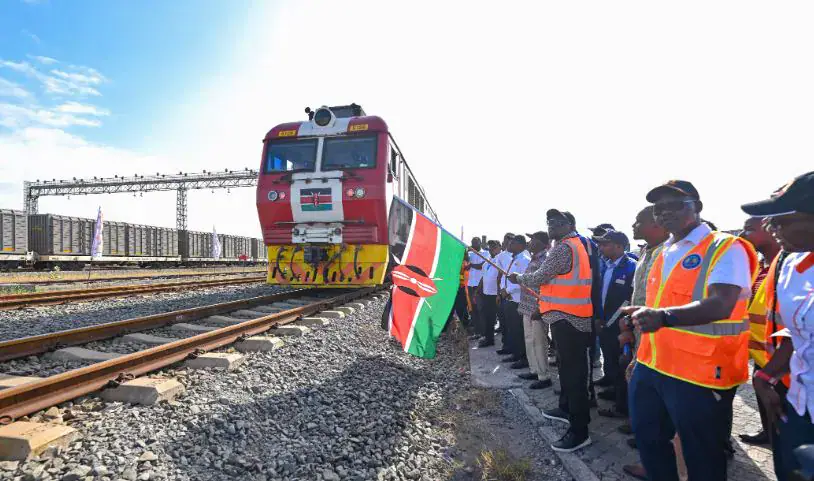
A recent World Bank report has shed light on the potential savings Kenya could have made on the construction of the Mombasa–Nairobi Standard Gauge Railway (SGR). According to the report, if Kenya's cost per kilometre had matched Tanzania's, the country could have saved up to Ksh117 billion. The World Bank's November 2026 Kenya Economic Update examines how governance weaknesses affect public spending, economic growth, and job creation. The report highlights that governance issues, including non-competitive contracting, land speculation, and fraudulent land titles, valuations, and compensation payments, account for at least 30 percent of the potential savings.
The World Bank estimates that Kenya spent about Ksh247 million more per kilometre than Tanzania, a 33 per cent premium over the Tanzanian benchmark. In comparison, Kenya's construction costs were US$7.6 million per kilometre, while Tanzania's Dar es Salaam–Dodoma line cost US$5.7 million per kilometre. The report also notes that Kenya's SGR cost Ksh299 million more per kilometre than the Djibouti–Addis Ababa railway, which cost US$5.3 million per kilometre. These findings suggest that Kenya's SGR was significantly more expensive than similar railway projects in the region.
The World Bank report clarifies that the estimated potential savings of Ksh117 billion represent a possible saving rather than definitive proof of stolen or recoverable funds. The report cites direct contracting rather than competitive tendering, land speculation, and suspected fraud related to land titling, valuation, and compensation as factors contributing to the high costs. The lender warns that limited competition can weaken scrutiny of contract prices and create opportunities for inflated costs.
The comparison between Kenya's SGR and Tanzania's Dar es Salaam–Dodoma line has limitations. Kenya's SGR is diesel-powered, while the Tanzanian and Djibouti–Addis Ababa lines are electrified, which requires additional infrastructure. The projects also differ in specifications, construction periods, terrain, and other physical conditions. Despite these differences, the World Bank notes that all three are single-track railways.
The World Bank report also acknowledges that land acquisition costs were significantly higher in Kenya but says they do not fully explain the cost difference. Tanzania's railway was built later and to a higher specification, including electrification. The report does not conclude that every additional shilling spent on Kenya's SGR resulted from corruption but identifies governance weaknesses as one explanation for part of the estimated potential savings.
The findings of the World Bank report echo Transparency International Kenya's June 2026 Corruption Risk Assessment of Infrastructure Projects, which examined vulnerabilities in major public investments, including the SGR. The report's conclusions are particularly significant for infrastructure financed through public borrowing, as construction costs affect taxpayers through debt repayments and other fiscal commitments.
The World Bank's report highlights the need for improved governance and transparency in public infrastructure projects. The report's recommendations aim to help Kenya and other countries in the region improve their infrastructure development and reduce the risk of corruption. By implementing these recommendations, Kenya can reduce the risk of corruption and ensure that public infrastructure projects are delivered efficiently and effectively.
Key points
- Kenya could have saved up to Ksh117 billion on the construction of the Mombasa–Nairobi SGR if its cost per kilometre had matched Tanzania’s.
- Governance weaknesses, including non-competitive contracting and land speculation, account for at least 30 percent of the potential savings.
- The World Bank report's findings echo Transparency International Kenya's June 2026 Corruption Risk Assessment of Infrastructure Projects.