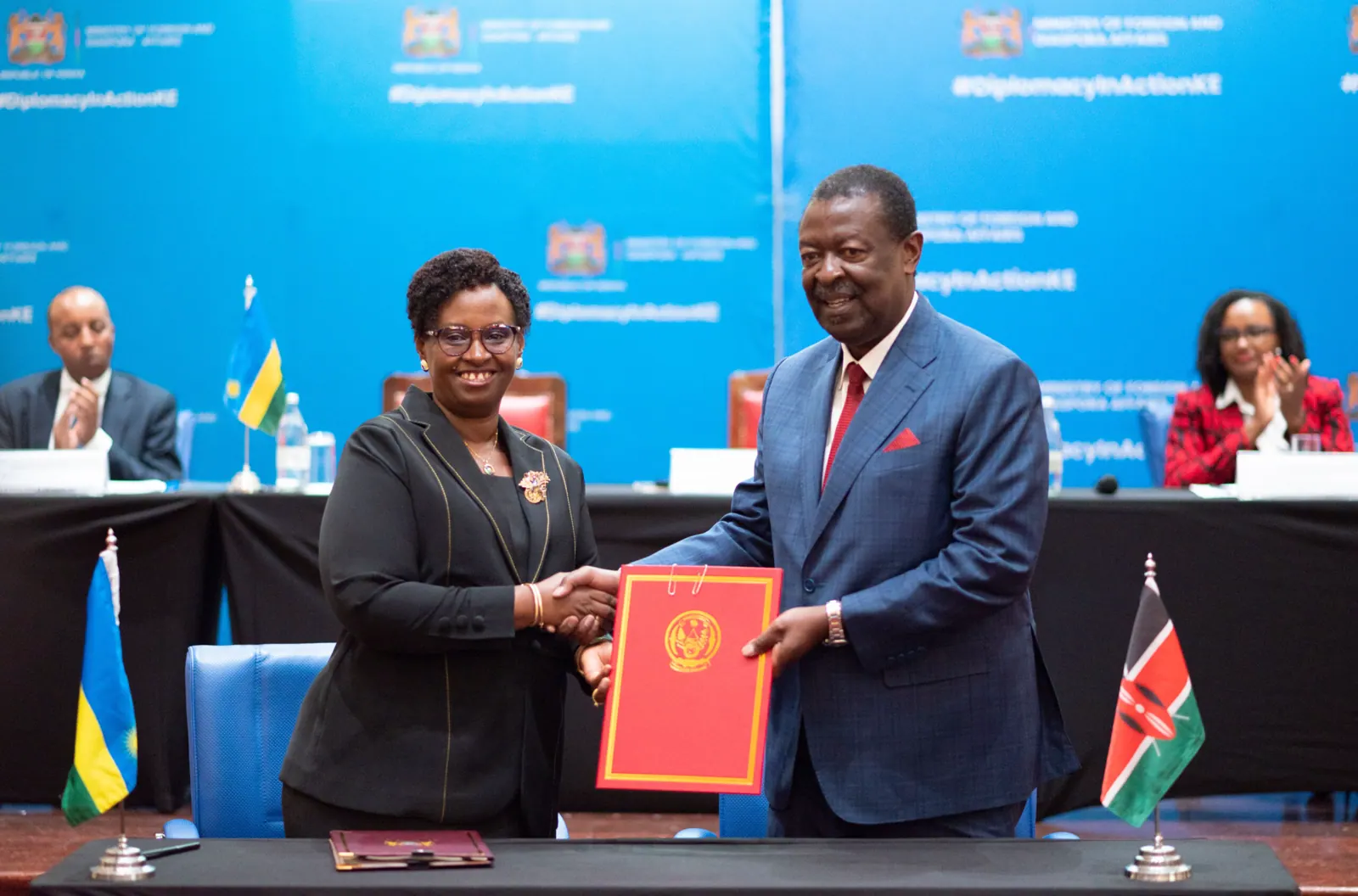
Rwanda and Kenya have strengthened their economic ties through a series of agreements, including Kenya's allocation of land to Rwanda at the strategic Miritini and Naivasha trade hubs. This development is a significant step towards deeper coordination and investment in the infrastructure that facilitates trade between the two countries. The allocation of land was one of the key outcomes of the 10th Kenya-Rwanda Joint Permanent Commission for Cooperation (JPCC) held in Nairobi. The meeting was led by Rwanda's Minister of State for Foreign Affairs and International Cooperation, Dr. Usta Kaitesi, and Kenya's Prime Cabinet Secretary and Cabinet Secretary for Foreign and Diaspora Affairs, Dr. Musalia Mudavadi.
The two-day meeting resulted in the signing of 11 bilateral instruments, including two agreements and nine memoranda of understanding, covering areas such as justice, immigration, water management, local governance, security, culture, and conservation. These agreements aim to enhance cooperation between the two nations and provide a foundation for stronger trade and investment. Kenya's Principal Secretary for Foreign Affairs, Dr. Korir Sing'oei, emphasized that the allocation of land at Miritini and Naivasha, along with other connectivity initiatives, would provide a foundation for stronger trade and investment between the two countries.
The allocated land at Miritini and Naivasha places Rwanda closer to two important points in the logistics chain linking the Port of Mombasa to the landlocked country and other inland markets. For Rwanda, access to Mombasa is a critical gateway to international trade, making the efficiency and cost of the Northern Corridor an economic concern. The Northern Corridor is a vital transportation route that connects Kenya's port city of Mombasa to landlocked countries such as Rwanda, Uganda, and South Sudan.
In January, Kenya and Rwanda formalized an arrangement for a Kenya Ports Authority liaison office in Kigali, providing a direct link between Rwandan businesses and Mombasa port services. The Kigali office serves as an interface with both Mombasa and the Naivasha Inland Container Depot, bringing port-related services closer to Rwandan users. This development is part of a broader effort to enhance trade and investment between the two countries.
On September 29, Rwanda received its maiden 40,000-tonne cargo of refined petroleum products at Mombasa's Kipevu Oil Terminal 2, marking the activation of a new supply route through Kenya's Northern Corridor. The shipment was part of a framework agreed upon by Rwanda and Kenya in June, comprising an MoU on petroleum imports through the Northern Corridor and two implementing agreements covering transportation and storage through Kenya's infrastructure.
The developments in the Kenya-Rwanda relationship point to a growing economic partnership, with a focus on enhancing trade and investment. Rwanda recently acquired a 1.05 percent stake in Kenya Pipeline Company during its IPO, giving it an investment position in an important part of the energy infrastructure serving the corridor. The two countries are working to ensure that the benefits of these initiatives are felt by businesses and citizens on both sides.
The agreements signed at the JPCC are expected to translate into practical cooperation, with a focus on implementing the commitments and ensuring sustained institutional follow-up. The two countries are committed to reviewing the status of their relations in various sectors, identifying areas where progress can be accelerated, and exploring new areas of cooperation. The relationship between Kenya and Rwanda is increasingly built around the movement of goods, capital, people, and services, with the Northern Corridor anticipated to become the physical backbone of a more integrated economy.
Key points
- Kenya allocates land to Rwanda at Miritini and Naivasha trade hubs to enhance bilateral trade and investment.
- The two countries sign 11 bilateral instruments to enhance cooperation in areas such as justice, immigration, and water management.
- Rwanda acquires a 1.05 percent stake in Kenya Pipeline Company, giving it an investment position in the energy infrastructure serving the corridor.