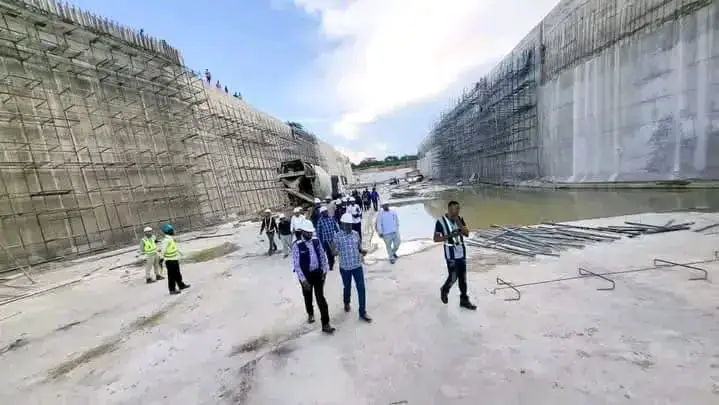
The construction of the Katende hydroelectric dam, a major energy project in Kasaï Central, Democratic Republic of Congo, is experiencing significant delays. The project, which aims to transform the economic landscape of the region, has only achieved a 25% execution rate. The delays are attributed to logistical constraints, financial difficulties, and tensions related to the fiscal environment of the executing company. A recent visit by the special representative of the head of state revealed that despite progress in some areas, the overall project is facing significant obstacles.
The project involves the construction of a hydroelectric dam on the Katende River, which is expected to provide a significant boost to the region's economy. The dam will have a major impact on the local population, providing electricity and creating new economic opportunities. However, the project's progress has been slow, with several key components, including the construction of dikes, topographic surveys, and site cleaning, already completed. The teams are currently working on excavation and canal development, essential operations for the configuration of the future hydroelectric infrastructure.
One of the major challenges facing the project is the state of the region's transportation infrastructure. The company responsible for the project, Angélique, has highlighted the poor condition of the Kananga-Tshimbulu and Tshimbulu-Bunkonde roads, which are essential for transporting construction materials, technical equipment, and other supplies. The lack of wagons for transporting equipment is also a significant constraint, complicating the logistics chain and undermining the regularity of operations on the site.
Financial difficulties are also a major concern for the executing company. According to reports, an outstanding invoice of approximately $4 million is yet to be paid by the Congolese government. This situation could have a significant impact on the company's ability to maintain the pace of investments necessary for the project's execution. The availability of financial resources is a critical factor in ensuring the continuity of work, equipment supply, and compliance with contractual commitments.
The company has also reported difficulties related to interventions by certain tax services, including the General Directorate of Taxes (DGI) and the General Directorate of Administrative, Judicial, Domain and Participation Revenues (DGRAD). These interventions are seen as fiscal harassment and are contributing to the complications in the company's operations. This raises concerns about the coordination between the imperatives of public revenue mobilization and the need to preserve a favorable environment for the execution of major infrastructure projects.
Despite the challenges, the project's prospects remain relatively encouraging. According to reports, the first electricity production could occur within a year, around the end of 2027. This deadline is eagerly anticipated in a province where access to electricity remains a central issue for economic and social development. The Katende hydroelectric dam is seen as a potential lever for supporting industrial activities, strengthening household energy supply, and promoting the emergence of new economic opportunities in Kasaï Central.
The project's success will depend on the ability of stakeholders to quickly address the identified obstacles. The Congolese authorities' concerted intervention is necessary to rehabilitate strategic road axes, improve railway transport capacities, settle outstanding financial commitments, and improve coordination with tax services. The Katende project represents more than just a construction site for Kasaï Central; it is an infrastructure that carries hope and whose realization could help reduce the energy deficit and open up new development perspectives.
Key points
- The project's execution rate is currently estimated at 25%.
- An outstanding invoice of approximately $4 million is yet to be paid by the Congolese government.
- The first electricity production could occur within a year, around the end of 2027.