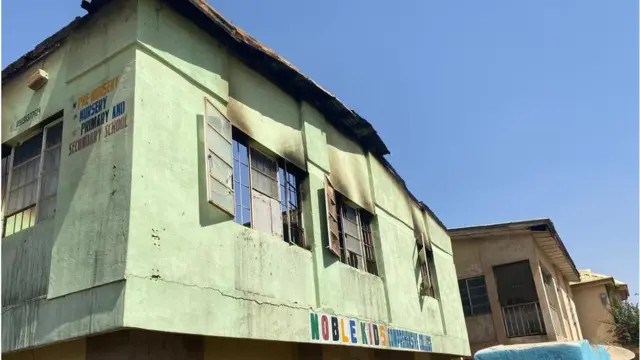
On January 24, 2022, a mob in Kano, Nigeria, set parts of Noble Kids Comprehensive College ablaze, days after the school's proprietor, Abdulmalik Tanko, confessed to the brutal murder of five-year-old pupil Hanifa Abubakar. The school, located in Kwanar Dakata, Nassarawa Local Government Area, had already been shut down by the state government, and suspects were in custody.
The fire was a manifestation of collective outrage over Hanifa Abubakar's death, which had become synonymous with the school. Hanifa was a pupil at Noble Kids Comprehensive College, and Abdulmalik Tanko, the man who kidnapped and murdered her, was the school's proprietor. When investigators confirmed Hanifa's remains were buried within premises connected to him, the line between the perpetrator, the institution, and the heinous act blurred irrevocably in the public mind.
This was not the first attempt to attack the school; several days earlier, youths had tried to burn the building but were thwarted by security personnel. The earlier attempt shows that the arson was not a spontaneous act, but rather a culmination of tensions that had been building around Noble Kids Comprehensive College as details of Hanifa's murder emerged. Security forces had recognised the school's potential as a focal point for public fury.
Residents described youths descending on the school around 1 a.m., setting the upper floor of the one-storey building ablaze. By morning, the damage was extensive, with shattered windows and blackened walls marking the physical scars of the community's fury. The Kano State Fire Service and local residents worked to prevent further destruction, and police spokesman Abdullahi Kiyawa confirmed the incident, noting no casualties from the fire itself.
The government had already ordered the school closed on January 21, three days prior to the fire. The fire served no practical purpose related to the investigation or the school's closure, but was purely an expression of a community's profound anger. The deliberate targeting of the structure highlights the deep emotional resonance the case held, demonstrating how a place could absorb the trauma of an event, becoming a canvas for collective grief and rage.
The building became a focal point for public fury due to its association with the crime. Hanifa Abubakar's tragic case forged an unbearable link between Noble Kids Comprehensive College and her death. Public knowledge that Abdulmalik Tanko, the accused, was the proprietor further solidified this connection. Reports indicated Tanko had leveraged his position and relationship with Hanifa during her abduction.
The Kano government faced immense pressure to ensure justice, leading to further measures, including withdrawing operational certificates for all private schools in Kano State, demanding revalidation. The fire illustrated that the anger was bigger than the school itself, a potent force that could not be contained by official directives alone.
Key points
- The arson was a manifestation of collective outrage over Hanifa Abubakar's death.
- The school was targeted due to its association with the crime and the proprietor's role.
- The incident led to further measures, including the withdrawal of operational certificates for private schools in Kano State.