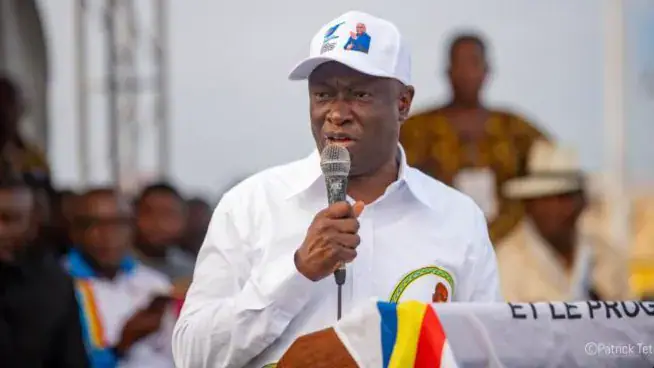
Augustin Kabuya, interim president of the ruling party UDPS/Tshisekedi, has sparked controversy with his recent remarks about the Catholic Church's role in Congolese politics. Speaking to party militants, Kabuya claimed that the Church, through its Conference of Catholic Bishops (CENCO), never helped the party achieve power. Instead, he attributed the party's 2018 electoral victory to its base and divine intervention.
Kabuya's comments have revived tensions between the UDPS and the Catholic Church. He cited two key events in Congolese history - the 1992 National Sovereign Conference and the 2016 New Year's Eve dialogue - as examples of the party's failed attempts to achieve power while collaborating with the CENCO. According to Kabuya, the party's decision to part ways with the CENCO was deliberate, as they realized that their collaboration was not yielding desired results.
The UDPS leader also alleged that the Catholic Church was among the first to contest the party's 2018 electoral victory. He expressed frustration with the Church's stance, stating that he no longer wants to discuss the matter. Kabuya's criticism of the CENCO has significant implications for the relationship between the ruling party and the Catholic Church, which remains a key player in Congolese politics and mediation efforts.
The Catholic Church has played a significant role in Congolese politics, often providing a platform for dialogue and mediation. However, Kabuya's comments suggest that the UDPS views the Church's influence as detrimental to their interests. The party's decision to distance itself from the CENCO appears to be a strategic move to assert its independence and challenge the Church's authority.
The controversy surrounding Kabuya's remarks highlights the complex dynamics between politics and religion in the Democratic Republic of Congo. The Catholic Church has historically been a influential force in Congolese politics, but the UDPS's criticism suggests that this influence is not universally welcomed. As the country navigates its complex political landscape, the relationship between the ruling party and the Catholic Church will likely remain a contentious issue.
Kabuya's criticism of the Catholic Church has also sparked debate about the role of religion in politics. While some argue that the Church has a legitimate role to play in promoting national dialogue and reconciliation, others see its involvement as an overreach. The UDPS's stance on the matter reflects a broader tension between the party and the Church, which is likely to continue shaping Congolese politics in the years to come.
The controversy surrounding Kabuya's remarks has sparked widespread interest in Congolese politics. As the country prepares for future elections, the relationship between the ruling party and the Catholic Church will likely remain a key issue. The UDPS's criticism of the CENCO has significant implications for the country's democratic development and the role of religion in politics.
Key points
- Augustin Kabuya criticizes the Catholic Church's role in Congolese politics, claiming it never helped the UDPS achieve power.