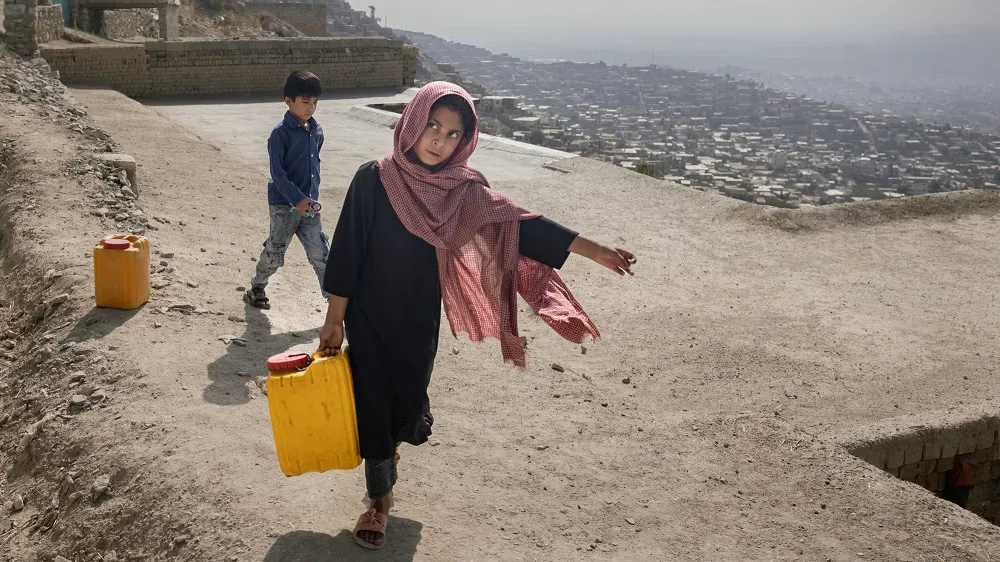
Kabul, Afghanistan's capital, is facing a severe water crisis, with residents struggling to access this vital resource. Shazia, a 34-year-old mother of three, knows firsthand what life is like without running water. She lives in the Khair Khana neighborhood with her husband, who works as a street vendor. The family has to walk to a local mosque and wait in line to fill buckets from a hand pump, a daily struggle that takes a toll on her back and her children's education.
Kabul's water crisis is not an isolated issue; cities worldwide, from Corpus Christi, Texas, to Tehran, Iran, are facing similar challenges. The root causes are often the same: booming populations, insufficient water infrastructure, and the climate crisis, which drives hotter, drier weather and disrupts the water cycle. Kabul's situation is particularly dire, given its rapid growth, climate vulnerability, and the impact of decades of conflict and reduced global aid since the Taliban's return to power in 2021.
The city's water system relies heavily on groundwater, which supplies 80% of residents. However, groundwater levels have plummeted by nearly 100 feet over the past decade, according to a report by Prosper Global. Water is being pumped out faster than it can be replenished, resulting in an estimated shortfall of over 1.55 billion cubic feet per year. Nearly half of the city's boreholes have dried up, leaving many neighborhoods without access to water.
The human-caused climate crisis has exacerbated Kabul's water crisis. Afghanistan has experienced six consecutive years of drought, with last year being one of the most severe. Snowfall in the Hindu Kush Himalaya, which feeds the Kabul River and recharges aquifers, reached a 25-year low at the end of last year. This long-term trend has seen snow levels decline by nearly 20% between 2014 and 2020.
Residents are feeling the effects of the water crisis. Mirza Jan, who lives in the Taimani neighborhood, has had to dig his well deeper over the years as it kept drying up. His well is now over 700 feet deep, an expensive endeavor made possible by money sent from his sons living in the US. Those who cannot afford to dig deeper wells rely on expensive tanker water or hand pumps at mosques, unsustainable options that have become a norm for many.
Experts warn that Kabul's situation will only worsen unless urgent action is taken. Mohd Faizee, a professor at the United Nations University Institute for Water, Environment and Health, describes the impending crisis as a "human catastrophe." The city's rapid expansion, with multistory buildings and a growing population, is putting immense pressure on already strained water resources. Kabul's population has ballooned from less than 1 million in 2001 to 6 million today.
As the water crisis deepens, residents are paying the price. Asadullah Ahmadi has been spending at least 150 Afghanis ($2) per day on water, a significant expense for his family. With no end to the crisis in sight, residents like Ahmadi are bracing for a difficult future. The city's vanishing groundwater is not a crisis, but a "water bankruptcy," according to Najibullah Sadid, a water and environment researcher.
Key points
- Kabul's water crisis is driven by booming populations, insufficient infrastructure, and the climate crisis.
- The city's groundwater levels have plummeted by nearly 100 feet over the past decade.
- Experts warn that Kabul's situation will only worsen unless urgent action is taken to address the water crisis.