Shareholder activist organisation Just Share is increasing pressure on Sasol to take its transition to a low-carbon economy seriously. In a report titled "Driving a credible and just transition at Sasol," Just Share questioned the pace and credibility of Sasol's plan to reduce its greenhouse gas emissions. The report highlighted Sasol's 2021 target of a 30% reduction in Scope 1 and 2 emissions by 2030 using a 2017 baseline. However, Just Share noted that Sasol's plan lacks sufficient detail, funding, and deliverability.
Sasol has maintained its commitment to addressing climate change, describing its approach as "deliberately pragmatic and value-led." The company pointed to a net 15% reduction in group Scope 1 and Scope 2 emissions by the end of the 2026 financial year against the 2017 baseline. Sasol also acquired 1.37GW in renewable energy, with 510MW already operational, and aims to have 2GW of renewable energy operational by 2030. The company emphasized that its focus is on delivering its 2030 target while ensuring practical, sustainable actions that support the long-term competitiveness of the business.
Just Share's report argued that Sasol's shift in direction towards saving cash, minimizing capital expenditure, and ramping up coal to liquids production rates raises concerns about its commitment to structural decarbonization. The report also noted that Sasol does not provide sufficient process-level detail, annual milestones, or quantified contributions from individual abatement measures to demonstrate how it will achieve its emission reduction targets. Just Share director Robyn Hugo emphasized that a credible transition at Sasol matters due to its significant footprint as the country's largest private greenhouse gas emitter.
Hugo noted that Sasol's economic importance is a reason to take its transition more seriously, not a reason to excuse the risks associated with its current business model. She emphasized that the greater the consequences of a poorly managed transition, the more important it is to address those risks early. Sasol supplies 30% of South Africa's liquid fuel requirements and supports 500,000 jobs throughout the value chain, making it a significant employer and one of the country's largest taxpayers.
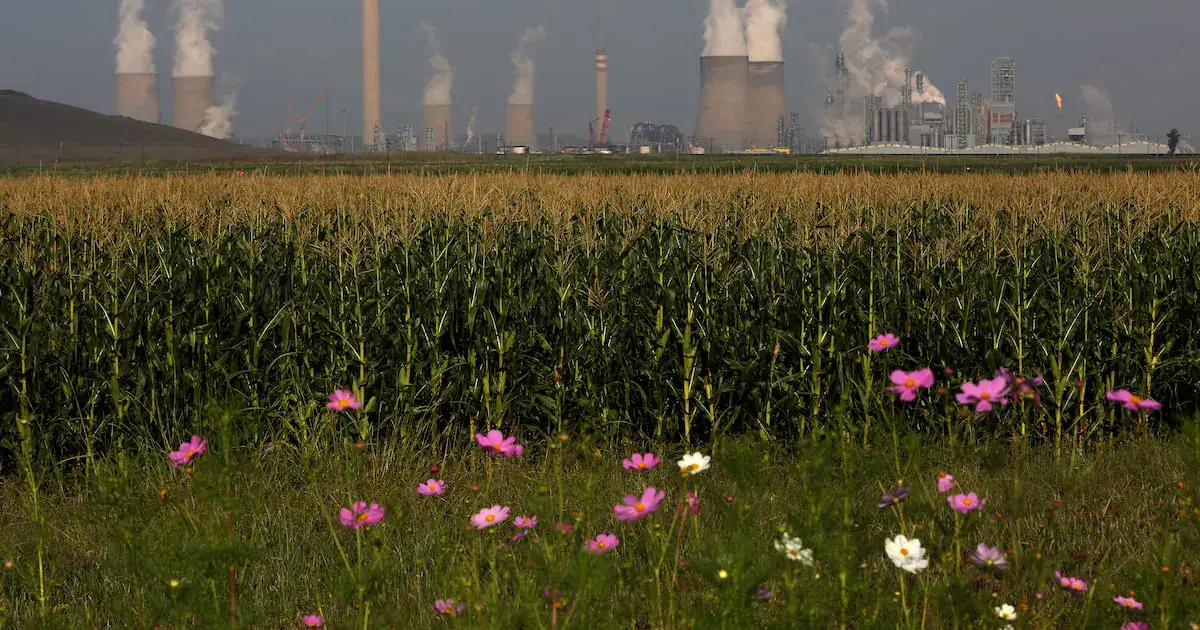
A report by the Centre for Research on Energy and Clean Air estimated that Sasol costs 1,000 deaths per year through pollution linked to its Secunda Operations, which accounts for 83.7% of Scope 1 and 2 emissions. The report also noted that industrial emissions from Secunda were responsible for a rotten egg smell for residents, sometimes traveling as far as Johannesburg and Pretoria. Sasol responded that it continues to bring renewable energy online and make progress on sustainable fuels and other lower-carbon opportunities.
Sasol emphasized that its transition is not premised on pursuing projects at any cost, but rather on allocating capital selectively with consideration given to project value, readiness, and the enabling policy and market environment. The company aims to reduce emissions while preserving the resilience and long-term sustainability of the business. With its significant role in South Africa's energy and industrial value chains, Sasol's approach to the energy transition has far-reaching implications.
As Sasol's annual general meeting approaches, the company's climate transition plan remains under scrutiny. While Sasol has made commitments to reducing its greenhouse gas emissions, concerns about the pace and credibility of its plan persist. The outcome of the AGM and Sasol's future actions will be closely watched by stakeholders, including investors, communities, and environmental groups.
Key points
- Sasol aims to reduce Scope 1 and 2 greenhouse gas emissions by 30% by 2030.
- Just Share's report raises concerns about Sasol's commitment to structural decarbonization.
- Sasol's operations are a major source of toxic air pollution, affecting public health and the environment.
Reporting sources
- Just Share presses Sasol on climate transition plan · The Rand Daily Mail